$1 Billion-Backed Xaira Launches Its First Virtual Cell Model
Xaira Therapeutics has announced X-Cell, the company's first virtual cell model. It is a 4.9-billion-parameter diffusion language model designed to predict how cells respond to genetic perturbations, including in biological contexts not seen during training. X-Cell is trained on X-Atlas/Pisces, which Xaira says is the largest and most context-diverse genome-wide CRISPRi Perturb-seq dataset ever reported.
Tracing Stars From Orion to Pisces
The launch builds on a trajectory visible since the company's founding. Xaira emerged in April 2024 with over $1 billion in funding, led by CEO Marc Tessier-Lavigne and co-founded by Nobel laureate David Baker. By June 2025, the company had released X-Atlas/Orion, a genome-wide Perturb-seq dataset covering approximately 8 million single cells in a single cellular context.
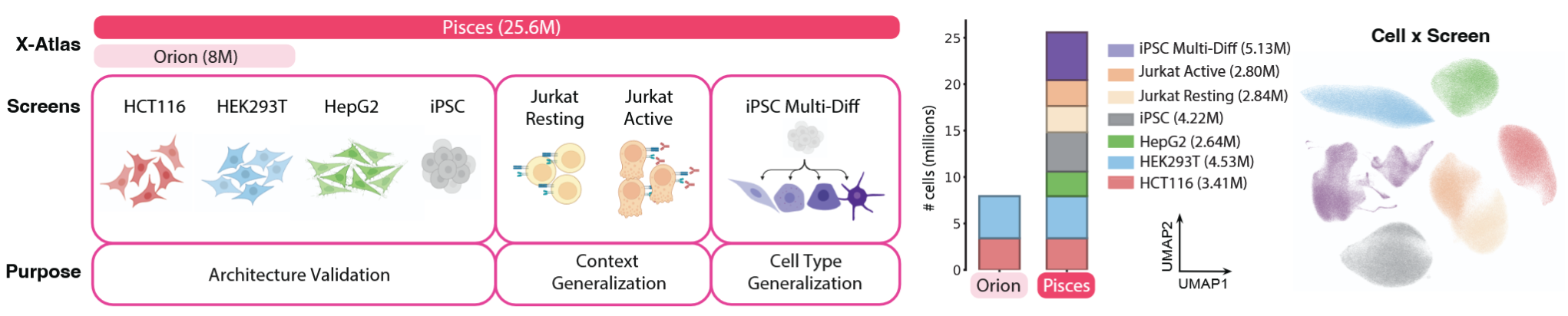
Overview of the X-Atlas/Pisces dataset, including its seven genome-scale Perturb-seq screens and comparison with the earlier X-Atlas/Orion dataset. Source: Xaira Therapeutics preprint.
X-Atlas/Pisces expands that foundation to 25.6 million perturbed single-cell transcriptomes, roughly three times the scale of Orion, spanning seven broad biological context groups and 16 conditions in total. These include widely used cell lines, induced pluripotent stem cells, resting and activated Jurkat T cells, and multi-lineage differentiating iPSCs. Where Orion provided depth in one setting, Pisces is designed to capture how regulatory dependencies shift across biological environments, a prerequisite for models meant to generalize beyond their training distribution.
Architecture: Why Diffusion?
Most existing single-cell foundation models use autoregressive architectures generating predictions token by token. X-Cell takes a different approach with a diffusion language model, an architecture more commonly associated with image generation tools like Stable Diffusion, but here applied to transcriptomic data.
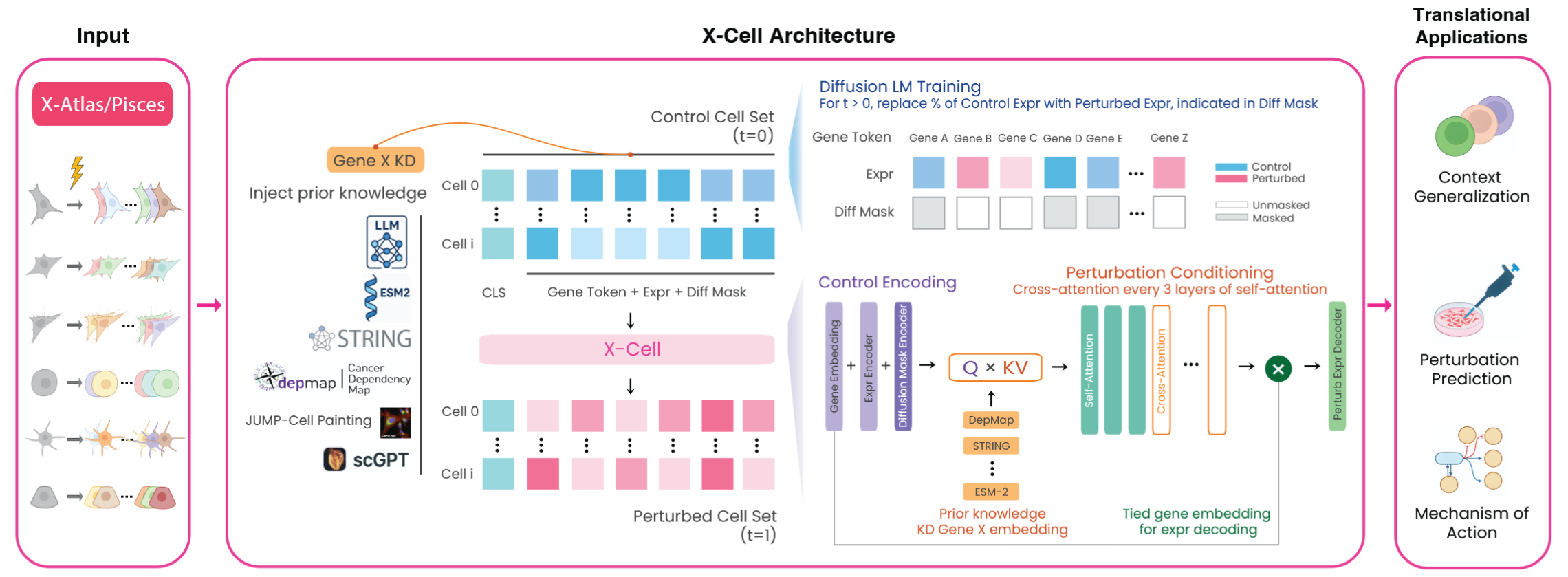
Overview of the X-Cell architecture, showing diffusion-based training and the use of cross-attention to incorporate prior biological knowledge. Source: Xaira Therapeutics preprint.
Instead of predicting a perturbed cell state in a single pass, X-Cell iteratively refines its outputs across multiple denoising steps, gradually transforming control-state gene expression toward a perturbed state. X-Cell also incorporates prior biological knowledge through cross-attention, allowing the model to place perturbations in a broader biological context using signals from protein language models, gene interaction networks, genetic dependency maps, morphological profiles, and natural-language gene descriptions.
The work is led in part by Bo Wang, SVP and Head of Biomedical AI at Xaira (joined in April 2025) and co-senior author of the preprint. Wang previously led the development of scGPT, a single-cell foundation model published in Nature Methods.
Performance and Scaling
According to Xaira's preprint, X-Cell outperforms existing models by up to five-fold on key metrics such as Pearson delta, which measures the correlation between predicted and observed perturbation-induced changes in gene expression. At its largest configuration (X-Cell-Ultra, 4.9 billion parameters), the model demonstrates zero-shot generalization to entirely unseen biological contexts like iPSC-derived melanocyte progenitors and primary human CD4+ T cells from multiple donors.

Size comparison of X-Cell model variants, from 55 million to 4.9 billion parameters, relative to other single-cell foundation models. Source: Xaira Therapeutics preprint.
Perhaps more notable is the scaling behavior. The preprint reports that perturbation prediction follows power-law scaling with an exponent matching large language models, meaning performance improves predictably as both data and model capacity increase. This is a meaningful claim for the field, given that recent work has suggested scaling model parameters alone does not reliably improve generalization in perturbation prediction.
Xaira's argument is that the missing ingredient has been causal interventional data scaled alongside model size, rather than relying on observational expression atlases that capture correlation but not causation.
Building “The Holy Grail” of Digital Biology
The modern AI ‘virtual cell’ was formalized in a 2024 Cell perspective led by Charlotte Bunne and colleagues, which described AI virtual cells as interconnected foundation models spanning molecules, cells, and tissues. X-Cell now enters a small but fast-moving set of efforts trying to instantiate parts of that vision in practice.
The Arc Institute's inaugural Virtual Cell Challenge, which drew over 5,000 registrants and 1,200 teams, found that perturbation prediction models are not yet consistently outperforming naive baselines across all metrics. The top-performing approaches combined deep learning with classical statistical features. In that context, Xaira’s reported five-fold improvement is notable, although comparisons outside the company’s own evaluation setup will matter.
Arc Institute has released two models of its own—State, a transformer-based model trained on perturbation data from over 100 million cells across 70 cell lines, and Stack, a foundation model that uses in-context learning where cells themselves serve as prompts to predict perturbation responses in new contexts.
The Chan Zuckerberg Initiative Biohub has taken yet another approach with rBio, a reasoning model trained on virtual cell simulations that lets scientists query perturbation effects in natural language.
One important distinction across these efforts is how heavily they rely on observational atlases versus causal perturbation data. Observational single-cell atlases are powerful for tasks like cell type annotation, but Xaira argues they are less suited to predicting how cells respond to perturbations such as gene knockdowns or drug treatments. Xaira is counting on large-scale interventional Perturb-seq data generated through its own platform, while Arc’s broader virtual cell stack incorporates both observational and perturbational data. Whether an interventional-first strategy yields a durable advantage in generalization is one of the questions X-Cell’s results put into sharper focus.
Xaira's roadmap calls for expanding X-Atlas into primary cells, iPSC-derived cell types, organoids, and in vivo perturbations. The downstream applications of target identification, mechanism of action, patient stratification, toxicity prediction—all remain prospective at this stage, but the data-and-model foundation is now in place for testing them.
Outside the model launch itself, Xaira has also started to outline where the platform may go commercially, with president and COO Jeff Jonker telling Fierce that the company is building in inflammatory and immunological disease and developing antibody therapeutics. Jonker also described Xaira as building an integrated R&D platform in which the machine-learning stack comes first and therapeutic programs are meant to follow from it.
A subset of the Pisces dataset and X-Cell model will be made available to the scientific community.
Topic: AI in Bio