GSK Licenses AI-Based Virtual Cell Models From Noetik in Five-Year Oncology Research Agreement
GSK has entered a five-year collaboration and licensing agreement with San Francisco–based Noetik to access AI foundation models focused on simulating human tumor biology in non-small cell lung cancer and colorectal cancer.
The deal includes a non-exclusive license to Noetik’s virtual cell models, joint data generation efforts, and a subscription-based access framework. Financial terms include $50 million in upfront capital and near-term milestones.
Under the agreement, GSK’s AI and therapeutics teams will gain direct access to Noetik’s OCTO-VC virtual cell foundation model for work in non-small cell lung cancer (NSCLC) and colorectal cancer (CRC). Noetik describes OCTO-VC as a spatial transcriptomics model trained with self-supervised learning to simulate spatially resolved single-cell gene expression in intact or “virtual” patient tissues, using prompts and local neighborhood context to predict gene expression patterns.
OCTO-VC builds on Noetik’s earlier OCTO platform (short for Oncology Counterfactual Therapeutics Oracle) which the company positioned as a broader world-model framework for patient-level spatial biology.
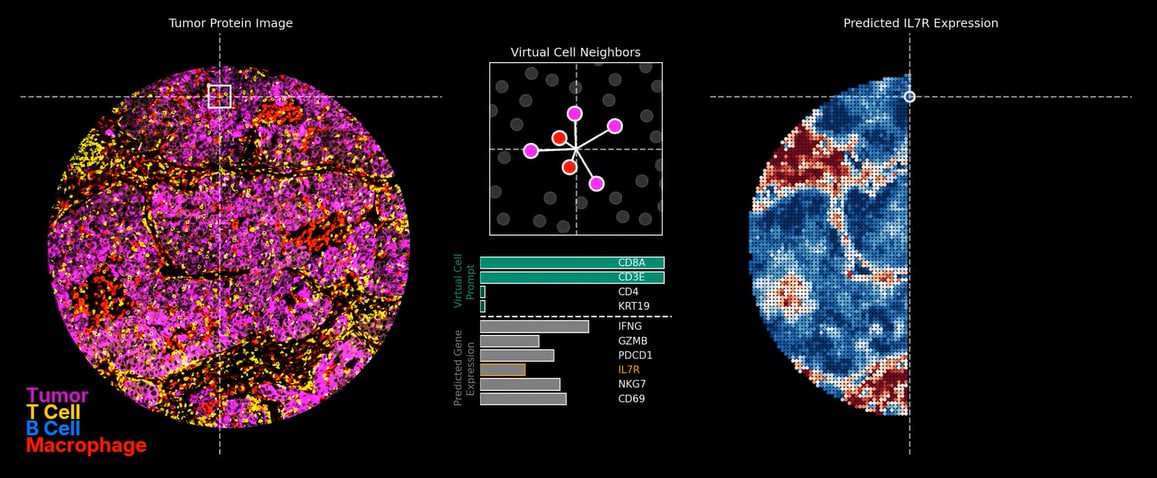
OCTO-vc, credit: Noetik
The companies also say the collaboration includes work to generate bespoke human spatial datasets aligned with GSK’s strategic priorities, with the intent that these data feed model use and extension inside GSK’s oncology workflows.
Background
Noetik was founded by former Recursion executives Ron Alfa and Jacob Rinaldi and is headquartered in San Francisco. In 2024, following a $40 million Series A financing, the company introduced OCTO-VC alongside a companion visualization environment, Celleporter. At launch, OCTO-VC was described as being trained on approximately 40 million spatially resolved cells spanning multiple cancer types. In recent press, Ron Alfa said the company’s goal has been to replace probabilistic “shots on goal” with deterministic cancer drug engineering.
Licensing Model
From a commercial standpoint, the structure of the GSK agreement emphasizes model licensing rather than project-scoped AI services. In addition to upfront and milestone-based payments, GSK will pay recurring annual fees to maintain access to the OCTO-VC models. This creates an ongoing subscription-style relationship tied to AI infrastructure rather than individual discovery programs.
Noetik’s Chief Business Officer, Shafique Virani, described the agreement as a move away from AI services collaborations toward licensing AI infrastructure, characterizing it as monetizing biological foundation models as scalable enterprise assets.
Technology Context
The partnership comes amid wider use of AI models designed to capture biological state and response directly, using large-scale, human-derived data. Recent analytical work on the field has described a “fourth wave” of AI adoption, characterized by foundation models, self-supervised learning, and large-scale human-derived datasets used to build holistic representations of biological systems. In this framing, AI is applied less to isolated tasks such as virtual screening and more to constructing global models of cellular and tissue-level biology that can support target selection, patient stratification, and translational decisions.
In 2025, the “virtual cell” idea drew more attention as foundation models, perturbation atlases, and multimodal datasets started to look like a viable substrate for reusable models of cell state and response. Our recent deep dive on the topic frames this as a restart after the 2012 Stanford whole-cell model, with the current wave shaped by transformers, large-scale data integration, and lab-in-the-loop workflows, and with patient-specific “virtual twins” as a recurring long-term use case.
Cover image adapted from Abhishaike Mahajan (Noetik), "How do you use a virtual cell to do something actually useful? 2/3", Noetik Substack, Sep 12, 2025.
Topic: Industry Movers