Inductive Bio Wins OpenADMET Blind Challenge With Machine Learning Models
Inductive Bio placed first in the OpenADMET-ExpansionRx blind challenge with its Beacon models, a large-scale industry competition for ADMET (Absorption, Distribution, Metabolism, Excretion, and Toxicity) property prediction, surpassing over 370 submissions from researchers across pharma, biotech, academia, and AI sectors.
The competition, run in partnership with Expansion Therapeutics (when?), focused on real-world datasets from discovery campaigns targeting myotonic dystrophy, ALS, and dementia, with participants predicting nine ADMET endpoints from previously unseen compounds. The win follows Inductive’s first-place ranking in the Polaris ADMET challenge in 2025 among 38 other participants. That same year the company raised a $25 million Series A led by Obvious Ventures to expand its pre-competitive data consortium and Compass software.
Inductive’s Beacon models predict how a compound will behave in the body based on its chemical structure. Trained on large, curated datasets, the models are designed to help researchers identify promising drug candidates earlier by forecasting key ADMET and pharmacokinetic properties with high accuracy. Each model is said to be fine-tuned to perform well across diverse chemical spaces and regularly updated with new data.
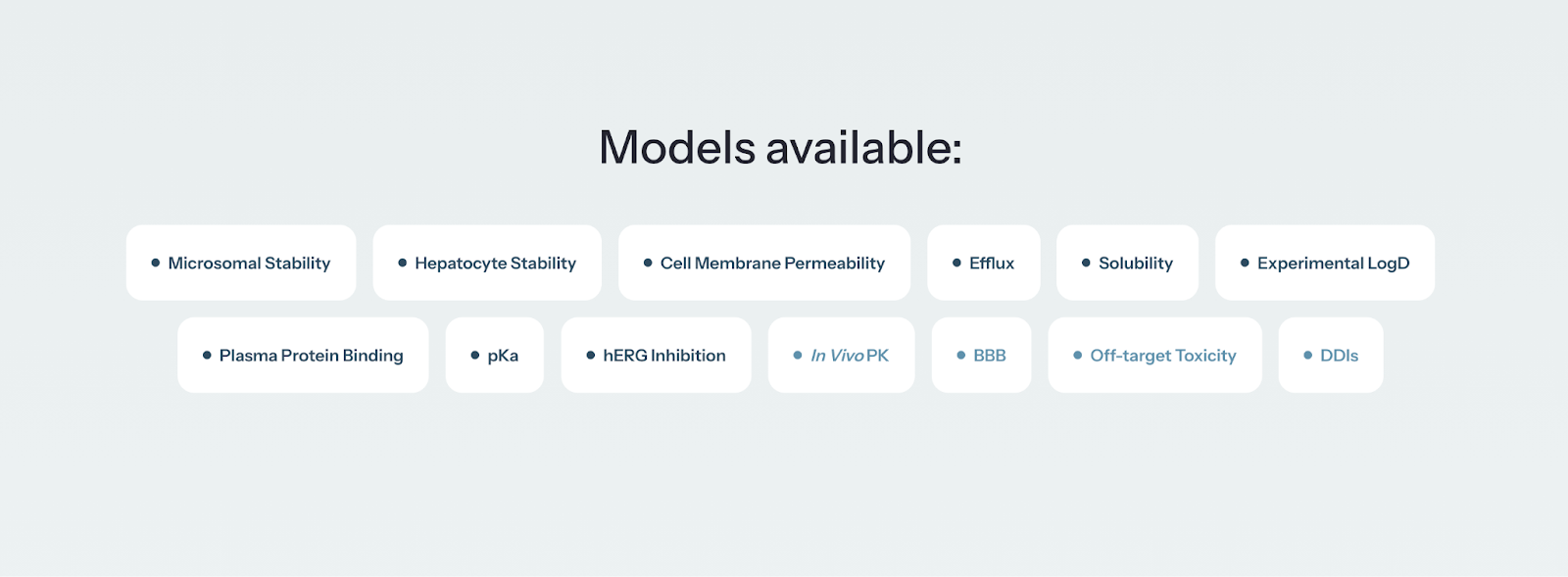
Image credit: Inductive Bio
Inductive Bio is based in New York and develops AI-powered virtual chemistry labs to support early drug discovery. The company was founded by Flatiron Health alumni Josh Haimson and Ben Birnbaum and emerged from stealth in December 2023 with a $4.3 million seed round co-led by a16z Bio+Health and Lux Capital, initially working with partners such as Denali Therapeutics on custom ADME models.
Its platform suite combines predictive ADMET and pharmacokinetics models, AI chemistry agents, and digital organ simulations. These systems are built to help drug discovery teams spot potential problems in molecules early and choose better candidates with a higher chance of working in real-world settings. The company’s architecture is designed to tighten the loop between in silico and wet lab cycles and speed up progression of drug candidates with favorable profiles.
In a collaboration with Nested Therapeutics, Inductive’s platform helped resolve permeability and metabolic stability issues and contributed to nominating a development candidate, documented in an ACS Medicinal Chemistry Letters paper.
See also: From Animals to Algorithms: How AI Brings Drug Testing Closer to Human Biology
The company recently secured up to $21 million from ARPA-H to lead the DATAMAP project with Amgen, Cincinnati Children’s, Baylor College of Medicine, and Torch Bio, generating organoid- and tissue-based datasets to train toxicity models intended to reduce reliance on animal testing and support regulatory-grade safety assessment.
Topic: AI in Bio


