MIT Team Behind Boltz Launches With $28M, Pfizer Collaboration, and Three Guarantees
Boltz has launched as a public benefit corporation and paired the company formation with three operational announcements: a $28 million seed financing, a multi-year collaboration with Pfizer, and a preview release of its hosted platform with two initial discovery agents.
The company frames its focus as building open biomolecular AI models and packaging them into products intended to be usable without specialist ML or infrastructure work.
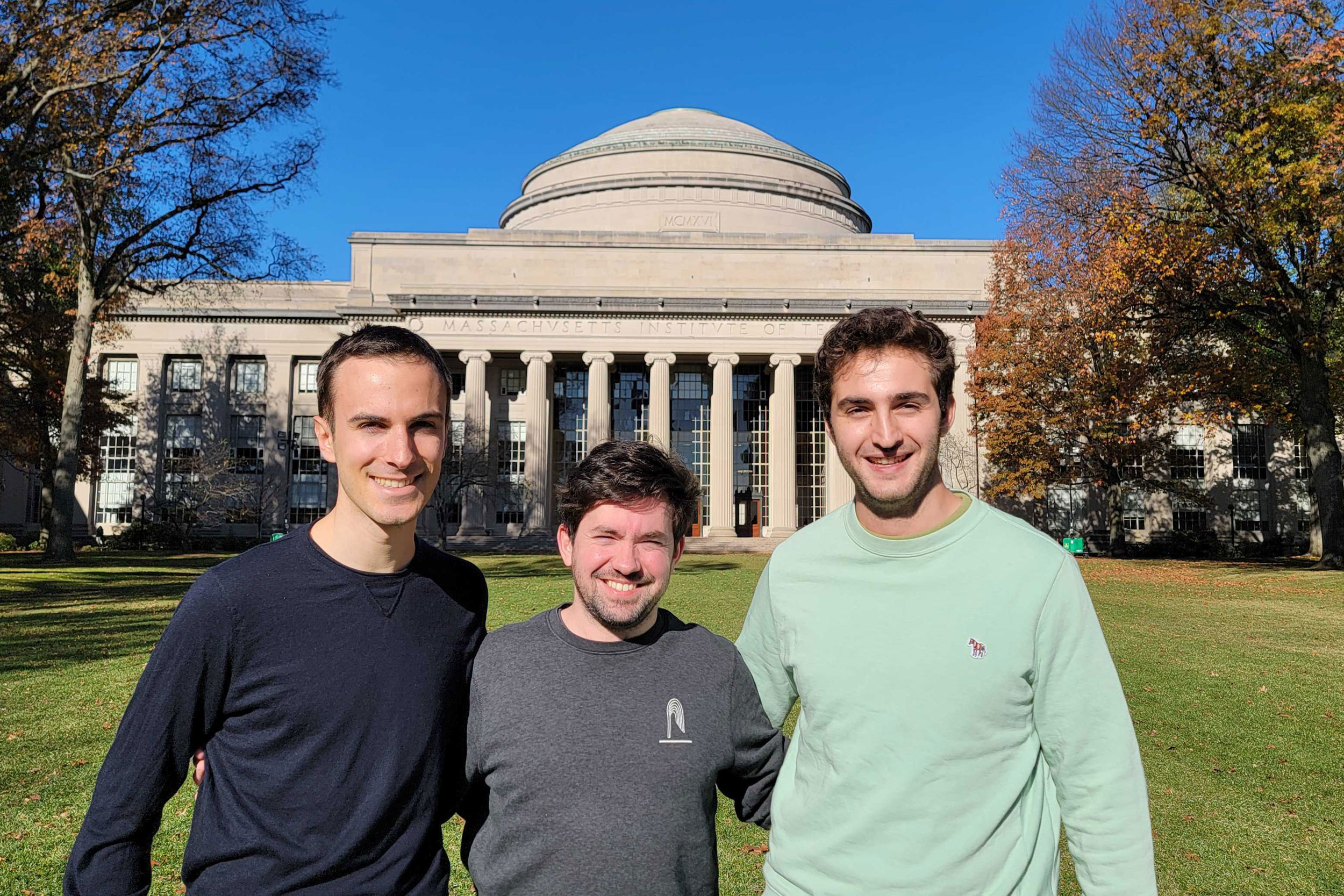
Boltz co-founders (from left to right): Gabriele Corso, Jeremy Wohlwend, and Saro Passaro; Source: MIT
Boltz is led by Gabriele Corso as CEO, alongside co-founders Jeremy Wohlwend and Saro Passaro, and traces its technical roots to MIT CSAIL, including work associated with Regina Barzilay’s group. The seed round was announced at $28 million, with Amplify Partners, Andreessen Horowitz, and Zetta Venture Partners named as leads, and additional participation listed in reporting and Boltz materials.
Models & Platform
Boltz frames its progress as a sequence of open releases that gradually expanded scope from structure prediction to affinity estimation and generative design:
- Boltz‑1 (November 2024): an open‑source model for predicting 3D structures of biomolecular complexes, positioned as approaching AlphaFold 3‑level accuracy, released with weights and code.
- Boltz‑1x (late 2024): a variant of Boltz‑1 introducing inference‑time steering techniques intended to improve structural validity.
- Boltz‑2 (June 2025): released in collaboration with Recursion as an open‑source foundation model for joint structure and affinity prediction, extending the original Boltz-1 framework into binding estimation.
- BoltzGen (November 2025): a generative protein design model capable of proposing binders for arbitrary targets, debuting later in 2025 following earlier academic validation.
- Boltz Lab platform and agents (January 2026): a hosted platform preview combining Boltz models with managed compute, infrastructure, and agent‑based workflows for discovery tasks.
The company says its models are used by more than 100,000 scientists across large pharmaceutical companies and thousands of biotechs, a scale it cites as a driver for moving beyond academic releases toward maintained products.
The hosted platform, Boltz Lab, combines its models and agents with compute, infrastructure, and collaboration-oriented interfaces. Boltz also lists three “guarantees” in the product post: users own what they build, customer data stays secure, and Boltz does not train on customer data.
Agents & Early Results
Boltz’s reports implementation details and early validation snapshots for the two initial agents:
-
Small-molecule agent: connecting an optimized version of Boltz-2’s affinity prediction with a parallel SynFlowNet in an active learning loop, and limiting returned hits to synthesizable molecules from Enamine REAL. Boltz reports an initial validation against TYK2 (excluded from training): 29 compounds ordered, 23 successfully synthesized, and among those 3 actives, 8 weakly active, 12 inactive, with a strongest reported binder at IC50 240 nM.
- Protein design agent: building on BoltzGen with a new scoring head intended to predict binding confidence more directly. Boltz reports retrospective benchmarking across multiple structure-based design systems (including BoltzGen, RFDiffusion, RFPeptides, Germinal, BindCraft), with an average retrospective enrichment of ~2x. It also reports early results suggesting an increase in identified nanobody binders “on the order of ~67%” relative to the previous model, while noting experimental validation is ongoing.
Boltz also links platform performance and cost to infrastructure choices and model optimization, including referencing NVIDIA cuEquivariance GPU kernels as part of speeding up expensive components of the model. The company manifesto explicitly positions it as a software and infrastructure provider rather than a therapeutics developer.
Boltz and Pfizer announced a strategic collaboration on January 8, 2026. With Boltz refining its foundation models on Pfizer’s historical data to create exclusive models for structure prediction, small-molecule affinity, and biologics design, and working with Pfizer teams on custom workflows for target programs. Pfizer will retain ownership of compounds discovered or developed with support from the Boltz platform.
Topic: Biotech Ventures