Bioptimus Releases Multimodal "World Model" For Biology Covering Histology, Transcriptomics, And Clinical Data
Bioptimus has announced M-Optimus, a foundation model trained on multimodal biomedical data including histology, bulk and spatial transcriptomics, and clinical records, aiming to simulate biological processes across cells, tissues, and patients. The model was trained on a proprietary dataset encompassing millions of patients across 50+ organ types and hundreds of medical centers.
Bioptimus positions M-Optimus as a response to the fragmentation of biomedical data systems, where models are typically trained on a single modality (e.g., genomics, histology, or clinical records) without capturing how these layers interact in real biology. By integrating multiple data types into a single model, the company aims to encode biological relationships across scales, from cell morphology to patient outcomes, enabling broader generalization and simulation capabilities.
M-Optimus is intended to serve as a general-purpose system for understanding biological complexity. It supports applications in drug discovery, trial design, and diagnostics by enabling prediction of gene expression, treatment responses, and clinical outcomes directly from histology or other standard inputs. The model also supports fine-tuning on proprietary datasets and generation of digital twins for in silico trials.
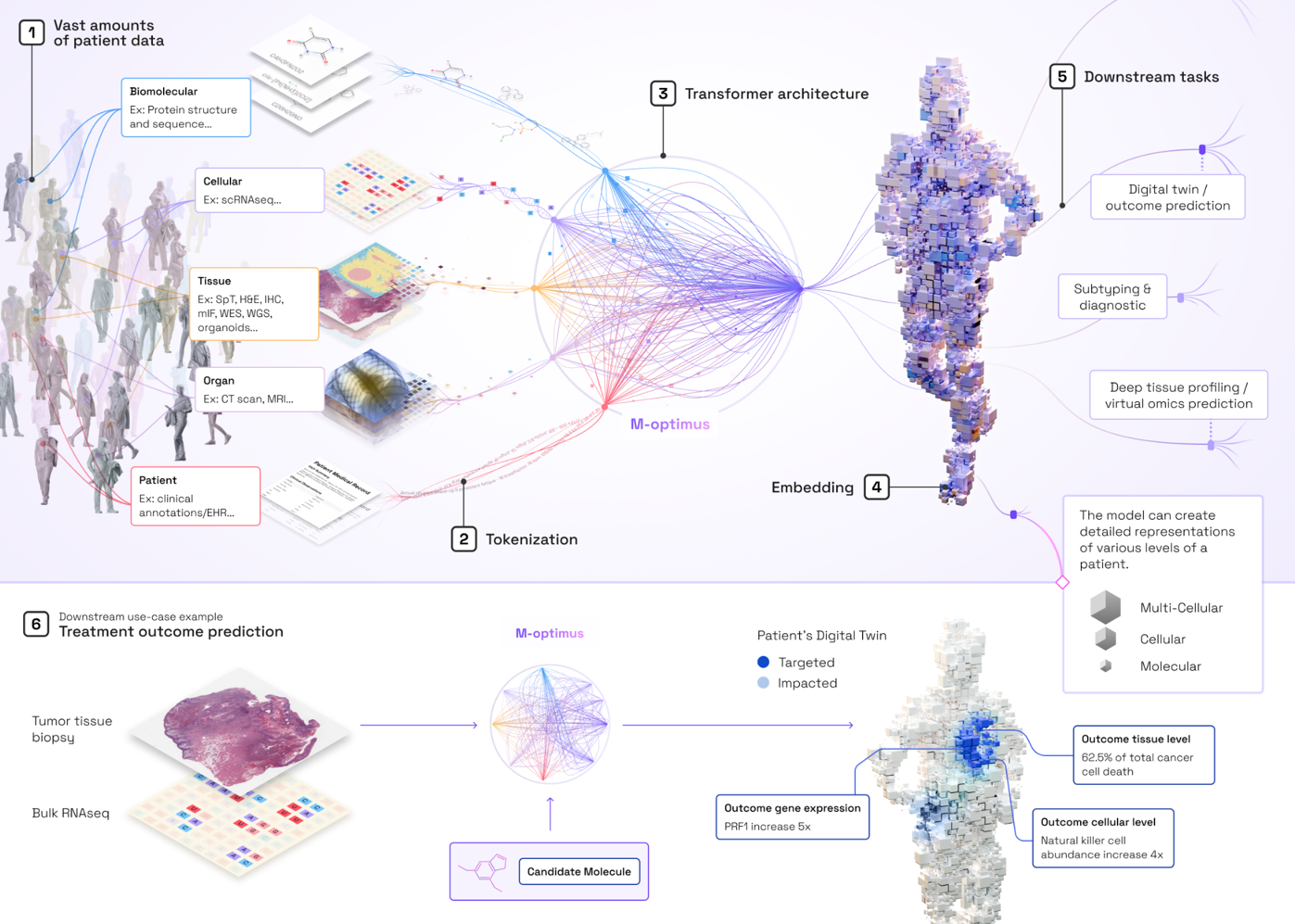
Bioptimus foundation models are built on tokenized, multi-scale and multimodal biological data, serving as a base layer for AI agents and deep discovery tools. They support tasks such as biomarker signature detection, cell population and tissue stratification, and patient subclass identification. The models can infer missing information across modalities, enabling use cases like digital twin generation and fully synthetic trial arms with in silico outcome prediction. Image: Bioptimus
A limited early-access program has been opened to select pharma clients already using the platform in research workflows. In parallel, Bioptimus is expanding access to its histopathology model H-Optimus-1 via AWS SageMaker, offering integration with cloud infrastructure for clinical and research deployment. H-Optimus-1, trained on millions of whole-slide images, is described as state-of-the-art in cancer grading and biomarker detection, and is reportedly in use at 12 of the top 20 pharmaceutical companies.
Jean-Philippe Vert, CEO and co-founder of Bioptimus, stated that with M-Optimus, the company has "assembled the first critical components of our journey to crack the code of biology by combining multiple modalities at scale." He added that the early access program is intended to engage "first-mover companies who share our vision: to translate this raw scientific power into tangible breakthroughs that ultimately improve patient outcomes and revolutionize the delivery of healthcare."
Bioptimus raised $35 million in seed funding in February 2024 to launch its work on AI foundation models for biology. By January 2025, it had reached a $76 million funding milestone following a $41 million round led by Cathay Innovation, with participation from Sofinnova Partners, Bpifrance, Andera Partners, and others. At the time, the company outlined plans to develop a multi-scale, multimodal AI foundation model targeting applications in medicine, biotech, and adjacent fields. This followed the launch of H-Optimus-0 in July 2024, an open-source pathology model trained on over 500,000 histopathology slides from 4,000 clinical centers. That model, reportedly containing 1.1 billion parameters, was described as the first in a planned series.
This autumn, Bioptimus also formalized its scientific strategy with the formation of a Scientific Advisory Board chaired by Sarah Teichmann (University of Cambridge) and including advisors from MIT, Columbia, Broad Institute, Gustave Roussy, and other institutions. The board includes experts in single-cell genomics, computational pathology, systems biology, and AI-guided drug discovery, intended to support the development of large-scale models integrating biological data from molecular to organismal levels. The company’s development is backed by partnerships with AWS, Hugging Face, NVIDIA, Owkin, and Proscia, with leadership experience from DeepMind, Google Brain, Owkin, and Tempus.
Topic: AI in Bio