BioPharmaTrend
Latest Insights
Companies
  • Companies Directory
  • Case Studies
Newsletter
About
  • At a Glance
  • Our Team
  • Advisory Board
  • Citations and Press Coverage
  • Partner Events Calendar
  • Advertise with Us
 
 Subscribe 
Sign in
  • AI in Bio
  • Tech Giants
  • Next-Gen Tools
  • Biotech Ventures
  • Business Intelligence

  Business Intellilgence

The Measurement Challenge in Longevity: Can Aging Biomarkers and Clocks Close the Gap?

by Louise von Stechow  (contributor )   •   Sept. 9, 2026

Disclaimer: All opinions expressed by Contributors are their own and do not represent those of their employers, or BiopharmaTrend.com.
Contributors are fully responsible for assuring they own any required copyright for any content they submit to BiopharmaTrend.com. This website and its owners shall not be liable for neither information and content submitted for publication by Contributors, nor its accuracy.

Share:   Share in LinkedIn  Share in Bluesky  Share in Reddit  Share in Hacker News  Share in X  Share in Facebook

An article published in Nature Biotechnology on 7 September 2026 by Alex Zhavoronkov’s team at Insilico Medicine and collaborators marks an important step forward for the field of drugs targeting aging. Using proteomics-based aging clocks, they showed that rentosertib, an anti-fibrotic that showed positive results in a Phase 2a trial in idiopathic pulmonary fibrosis, was associated with reductions in predicted biological age based on serum proteomic markers. This is not only a scientific milestone but also a methodological one, pointing the way for the use of aging clocks in trials of geroprotective medicines.
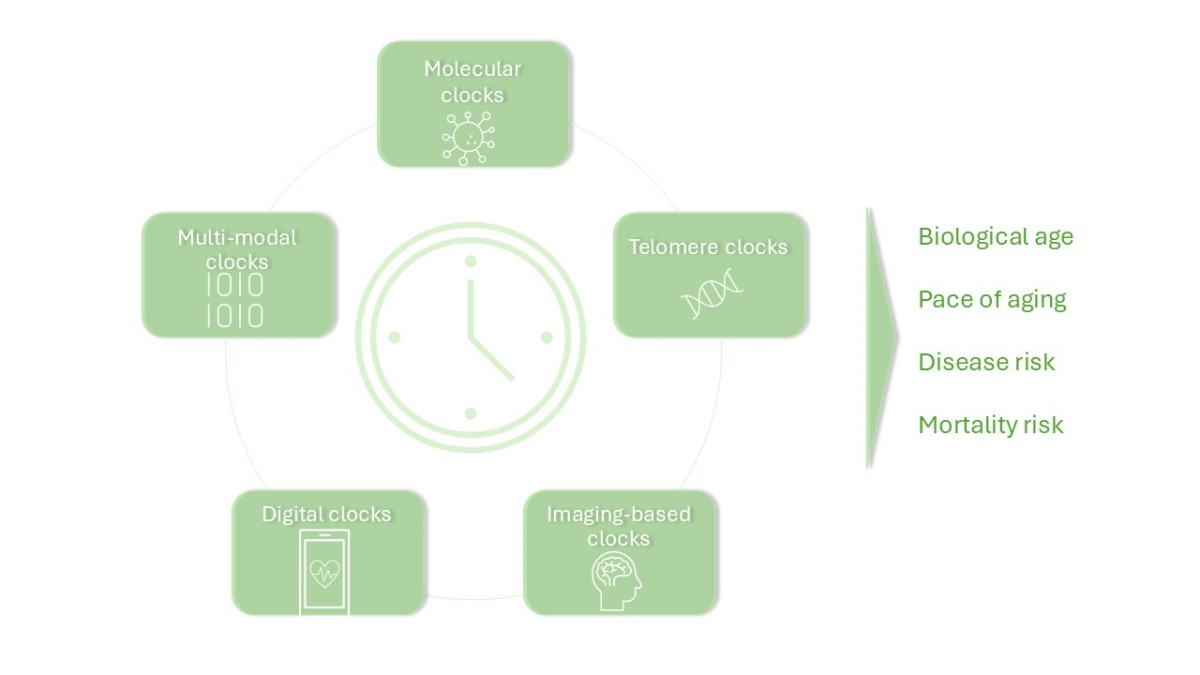
Aging Clocks

Targeting and measuring biological aging 

A growing number of longevity-focused biotech companies are testing interventions that aim to modify aging biology, from senolytics and immune-function enhancement to metabolic interventions, cellular reprogramming, and tissue engineering. Yet robust measurement of aging itself in humans remains a central bottleneck, complicating the testing of preventive and therapeutic strategies.

In the absence of a clear framework for measuring the process of aging beyond chronological age, most longevity drug development has focused on age-related proxy diseases. At the same time, a growing biomarker industry is trying to address this measurement gap. Academic groups and biotech companies are developing and validating markers linked to “biological age”, a concept intended to capture the physiological state of an organism, organ, tissue, or cell. Biological age can be distinct from an individual’s chronological age and differ for different organs and body systems. 

A particularly active field of aging biomarker research is that of so-called aging clocks. For such aging clocks biomarkers or biomarker profiles are translated into predictive biological age scores using computational models. While hundreds of aging clocks have been developed, noisy data, a lack of standardized validation, and missing causal links to aging biology currently still limit their use in clinical research and their value as interpretable, consumer-facing tools. However, trials that validate and benchmark these markers are underway to establish reliable aging biomarker profiles and support their integration into regulatory frameworks. Predictive biomarker profiles, whether expressed as aging clocks or in other formats, could become important tools for aging research, longitudinal monitoring and treatment-response assessment in clinical development, routine clinical monitoring, and consumer health tracking.


The drug-development bottleneck – why aging is hard to measure


To read the rest of this article, upgrade to a BiopharmaTrend Pro subscription.

Gain full access to all of our deep dives and content archives.

 Upgrade to Pro 

Already a member? Sign in here.
Insilico Medicine
Share:   Share in LinkedIn  Share in Bluesky  Share in Reddit  Share in Hacker News  Share in X  Share in Facebook

BiopharmaTrend.com

Where Tech Meets Bio
mail  Newsletter
in  LinkedIn
x  X
rss  RSS Feed

About


  • What we do
  • Press & Citations
  • Terms of Use
  • Privacy Policy
  • Cookies Policy
  • Disclaimer

Topics


  • News
  • AI in Bio
  • Tech Giants
  • Next-Gen Tools
  • Biotech Ventures

Explore


  • Premium Insights
  • Business Intelligence
  • Companies
  • Events
  • Authors

Partner


  • Sponsorship
  • Editorial Calendar

© WTMB Research & Media, S.L. (WTMB Group)   2026
We use cookies to personalise content and to analyse our traffic. You consent to our cookies if you continue to use our website. Read more details in our cookies policy.