BioPharmaTrend
Latest Insights
Companies
  • Companies Directory
  • Case Studies
Newsletter
About
  • At a Glance
  • Our Team
  • Advisory Board
  • Citations and Press Coverage
  • Partner Events Calendar
  • Advertise with Us
 
 Subscribe 
Sign in
  • AI in Bio
  • Tech Giants
  • Next-Gen Tools
  • Biotech Ventures
  • Business Intelligence

  Business Intellilgence

13 Foundation Models: Startups, Industry Updates and the Nobel Prize

by BiopharmaTrend   •   March 28, 2025

Disclaimer: All opinions expressed by Contributors are their own and do not represent those of their employers, or BiopharmaTrend.com.
Contributors are fully responsible for assuring they own any required copyright for any content they submit to BiopharmaTrend.com. This website and its owners shall not be liable for neither information and content submitted for publication by Contributors, nor its accuracy.

Share:   Share in LinkedIn  Share in Bluesky  Share in Reddit  Share in Hacker News  Share in X  Share in Facebook

Since our previous overview of foundation models and start-ups in the life science field, a historical event took place on October 9th, 2024: the Nobel Prize in Chemistry was awarded to David Baker, Demis Hassabis, and John Jumper for their contributions to computational protein design and AI-driven protein structure prediction.

The significance of their discoveries lies in previously unmatched accuracy in structure prediction (median backbone accuracy of 0.96 Å r.m.s.d. for AlphaFold) and remarkable scalability in handling complex protein structures.
Hassabis and Jumper developed AlphaFold, an AI model capable of predicting 3D protein structures from amino acid sequences, reducing the time and effort traditionally required for experimental methods from several years to minutes. In parallel, David Baker’s RoseTTAFold advanced computational protein design further.

Introduced in 2021, RoseTTAFold is a three-track neural network that simultaneously considers patterns in protein sequences, amino acid interactions, and potential 3D structures, enabling fast and accurate protein structure prediction. The Nobel committee's recognition shows that foundation models like AlphaFold and RoseTTAFold redefine our approach to understanding and engineering proteins.

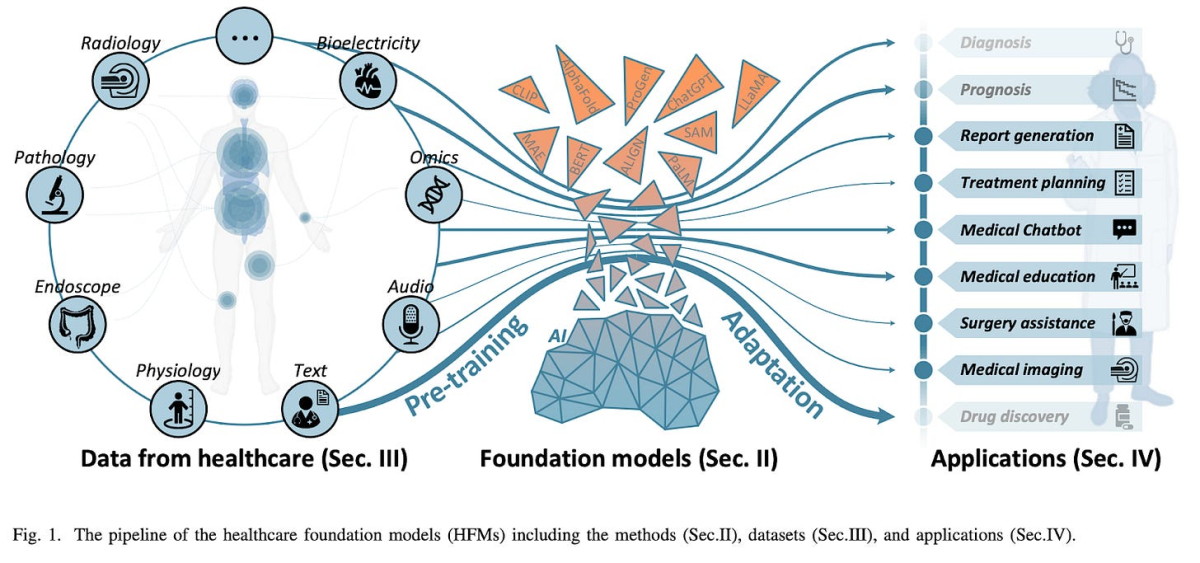
Defining Foundation Models — A foundation model is a large-scale AI system pre-trained on extensive, diverse datasets, enabling it to function as a universal base for multiple specialized applications. These models employ self-supervised learning to capture complex patterns in data without the need for manually labeled examples. For instance, in natural language processing, they predict the next word in a sequence based on contextual clues. In computer vision, they recognize and generate images by discerning complex visual patterns. The key characteristic that makes these models “foundational” is their capacity to generalize across tasks—whether it is generating human-like text, interpreting images, or predicting protein structures—thus significantly reducing the need to develop separate, task-specific models.

From “Foundation Model for Advancing Healthcare: Challenges, Opportunities, and Future Directions” (arXiv:2404.03264)


10 Foundation Model Startups

Variant Bio

Variant Bio, based in Washington, USA, is developing foundation models through its proprietary VB-Inference platform. This platform integrates deep phenotyping and multi-omic data using statistical genetics and AI/ML approaches to identify and validate therapeutic targets.

By analyzing genetic data from diverse populations, including those with unique genetic architectures and exceptional health-related traits, Variant Bio aims to uncover novel genetic factors associated with disease resistance and health. Their approach focuses on tailoring treatments based on comprehensive genetic insights.

In January 2025, Variant Bio entered into a multi-year research collaboration with Novo Nordisk, a global leader in metabolic disease treatment. The partnership is focused on identifying and validating novel targets for metabolic diseases, leveraging Variant Bio's genomic research capabilities.

Novo Nordisk committed an upfront payment and additional near-term R&D funding totaling up to $50 million, with potential for further milestone payments. Notably, this collaboration provides financial benefits for the communities that contributed genetic data, aligning with Variant Bio's ethical data-sharing program.


To read the rest of this article, upgrade to a BiopharmaTrend Pro subscription.

Gain full access to all of our deep dives and content archives.

 Upgrade to Pro 

Already a member? Sign in here.
Share:   Share in LinkedIn  Share in Bluesky  Share in Reddit  Share in Hacker News  Share in X  Share in Facebook

BiopharmaTrend.com

Where Tech Meets Bio
mail  Newsletter
in  LinkedIn
x  X
rss  RSS Feed

About


  • What we do
  • Press & Citations
  • Terms of Use
  • Privacy Policy
  • Cookies Policy
  • Disclaimer

Topics


  • News
  • AI in Bio
  • Tech Giants
  • Next-Gen Tools
  • Biotech Ventures

Explore


  • Premium Insights
  • Business Intelligence
  • Companies
  • Events
  • Authors

Partner


  • Sponsorship
  • Editorial Calendar

© WTMB Research & Media, S.L. (WTMB Group)   2026
We use cookies to personalise content and to analyse our traffic. You consent to our cookies if you continue to use our website. Read more details in our cookies policy.