BioPharmaTrend
Latest Insights
Companies
  • Companies Directory
  • Case Studies
Newsletter
About
  • At a Glance
  • Our Team
  • Advisory Board
  • Citations and Press Coverage
  • Partner Events Calendar
  • Advertise with Us
 
 Subscribe 
Sign in
  • AI in Bio
  • Tech Giants
  • Next-Gen Tools
  • Business Intelligence

  Business Intellilgence

Is the Future of AI Drug Discovery Hybrid?

by Andrii Buvailo, PhD   •   June 1, 2026

Disclaimer: All opinions expressed by Contributors are their own and do not represent those of their employers, or BiopharmaTrend.com.
Contributors are fully responsible for assuring they own any required copyright for any content they submit to BiopharmaTrend.com. This website and its owners shall not be liable for neither information and content submitted for publication by Contributors, nor its accuracy.

Share:   Share in LinkedIn  Share in Bluesky  Share in Reddit  Share in Hacker News  Share in X  Share in Facebook

Some field notes from the cutting edge of modern bioinformatics (CoFold Summit and Free Energy Workshop, both held recently in Barcelona, Spain). ALSO: several companies to watch in techbio space.

Everyone is talking about frontier AI models and agents. But the most interesting conversations I had in Barcelona earlier this month during two cutting-edge bioinformatics events pointed in a different direction.
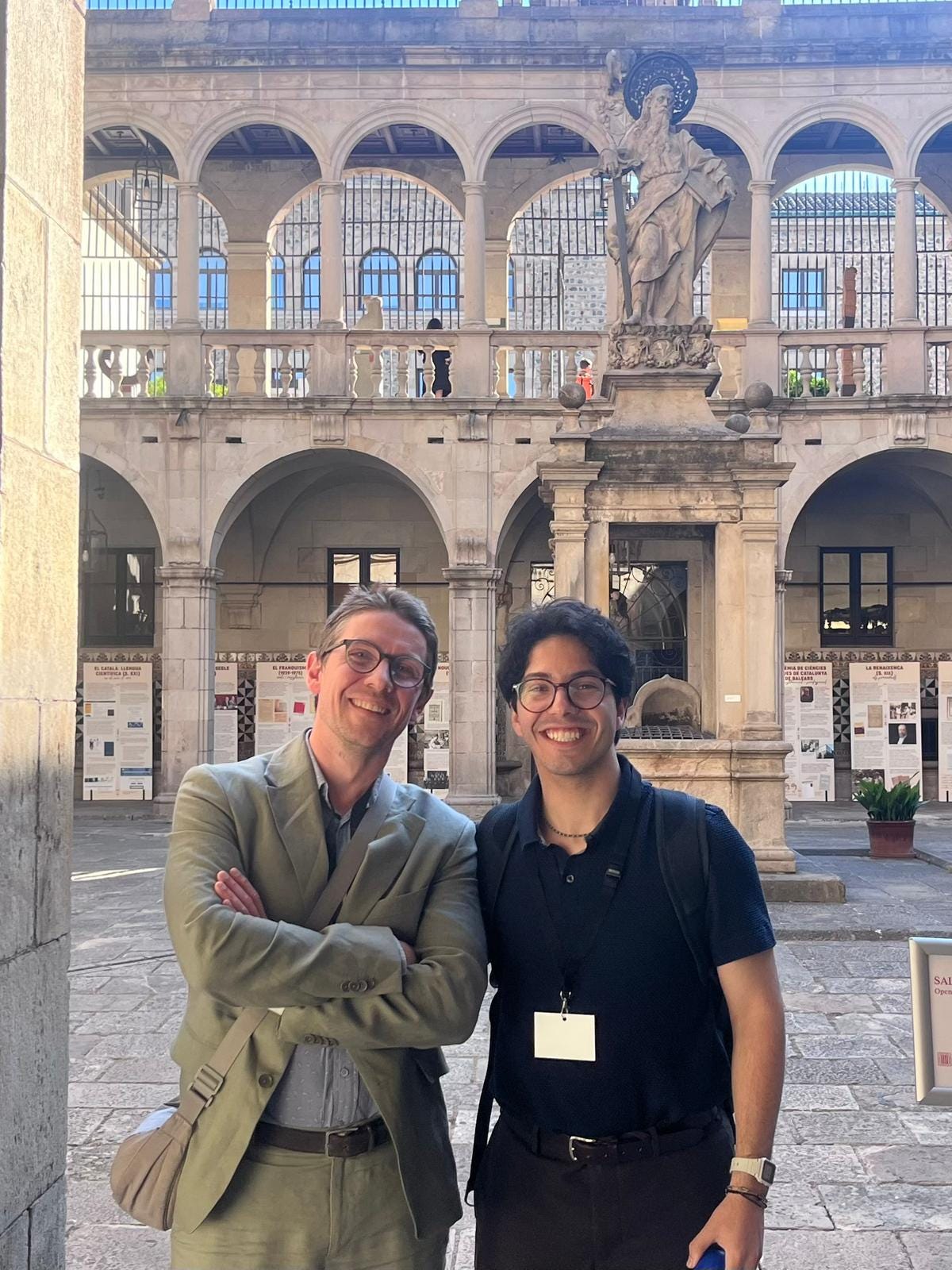
I attended two events back-to-back: the Alchemistry Workshop on Free Energy Methods (May 4–6) and the inaugural CoFold Summit (May 6).


Attending both events in Barcelona together with Andre Hurtado, a full-stack AI drug discovery engineer — good company for navigating two packed bioinformatics events in just several days.

The first is the established annual conference for physics-based drug design, with participation and sponsorships from companies like Schrödinger, AstraZeneca, Cresset, OpenBioSim, etc. The second brought together the teams building deep learning co-folding models — Isomorphic Labs, Boltz, OpenFold, RoseTTAFold, SandboxAQ, and others. Same city, same week, overlapping audiences.

Frontier AI models alone won’t get you far in biology. We need to invest in physics-grounded tools and methods.

Anyway, speaking about free energy perturbation methods, they have become the industrial workhorse for binding affinity prediction, and GPU acceleration has moved them from supercomputers to everyday pharma workflows. But FEP needs good starting structures, and it struggles with structurally diverse compounds coming out of generative AI pipelines. On the co-folding side, models like Boltz-1x are making real progress on the chemical validity of predicted poses. But they still default to well-represented binding sites from training data and can’t reliably score what they generate. Allosteric pockets, novel targets, anything underrepresented, still a major challenge.

The pattern kept coming up in different sessions and hallway conversations. Co-folding generates structural hypotheses from sequence alone. Physics-based methods provide rigorous validation. Neither works well in isolation.

The companies doing interesting work at this interface — SandboxAQ, Genesis Molecular AI, Iambic, Schordinger, etc., seem to get this. The real progress is hybrid: learning-based generation feeding into physics-based refinement.

I think the current hype around general-purpose AI agents obscures something important about the pharma and biotech realm of AI progress. In drug discovery, binding is fundamentally a physics problem. Models trained on data can approximate physics, but they can’t replace it, not yet. The teams investing in both sides are the ones to watch.

Now, since conferences were specifically focused on FEP and co-folding methods, I decided to share a couple of trends in those areas here:

Observations about free energy perturbation methods

Free energy perturbation calculations can now reliably predict how well a molecule binds to a protein target. What used to require supercomputers and deep specialist knowledge now runs on a few GPUs, thanks to better hardware and better classical force field parameterization.

To read the rest of this article, upgrade to a BiopharmaTrend Pro subscription.

Gain full access to all of our deep dives and content archives.

 Upgrade to Pro 

Already a member? Sign in here.
Share:   Share in LinkedIn  Share in Bluesky  Share in Reddit  Share in Hacker News  Share in X  Share in Facebook

BiopharmaTrend.com

Where Tech Meets Bio
mail  Newsletter
in  LinkedIn
x  X
rss  RSS Feed

About


  • What we do
  • Press & Citations
  • Terms of Use
  • Privacy Policy
  • Cookies Policy
  • Disclaimer

Topics


  • News
  • AI in Bio
  • Tech Giants
  • Next-Gen Tools

Explore


  • Premium Insights
  • Business Intelligence
  • Companies
  • Events
  • Authors

Partner


  • Sponsorship
  • Editorial Calendar

© WTMB Research & Media, S.L. (WTMB Group)   2026
We use cookies to personalise content and to analyse our traffic. You consent to our cookies if you continue to use our website. Read more details in our cookies policy.