Life Biosciences Gets $80M as Cellular Rejuvenation Enters the Clinic
Boston-based Life Biosciences, co-founded by David Sinclair, has closed an $80 million Series D financing to fund its first-in-human clinical program and extend operations into 2027. The capital is allocated primarily to a Phase 1 trial of ER-100 in optic neuropathies and to further development of its Partial Epigenetic Reprogramming platform, which aims to modify cellular aging processes at the transcriptional level.
Prior to the current Series D raise, Life Bio raised a $82M Series C in 2022 and a $50M Series B round in 2019.
Life Biosciences was founded in 2017 and refers to its method as partial epigenetic reprogramming, a subset of approaches grouped under cellular rejuvenation. The concept builds on Nobel Prize–recognized work in cellular reprogramming and has driven the formation of multiple startups.
Epigenetic reprogramming aims to reverse age-related changes in how genes are regulated rather than altering the DNA sequence itself. Over time, cells accumulate epigenetic modifications that shift gene activity and contribute to functional decline across tissues.
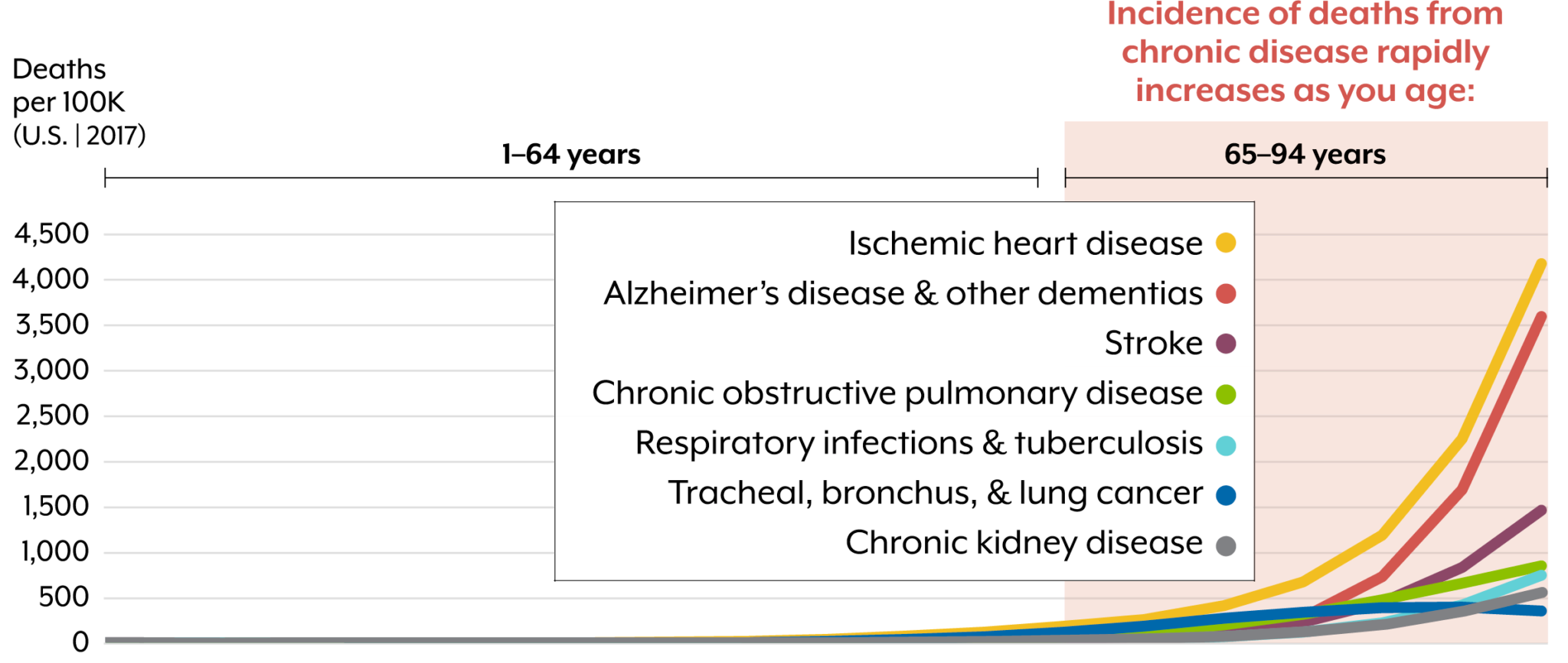
Global Burden of Disease Collaborative Network, Life Biosciences
Within this landscape, the company moved ahead earlier this year by becoming the first to receive FDA clearance to initiate a clinical trial of a partial epigenetic reprogramming therapy.
Upon its funding, Life Biosciences planned to target eight aging-related biological pathways, and since then had reduced its scope to three programs by 2021, before ultimately concentrating on partial epigenetic reprogramming under CEO Jerry McLaughlin.
The approach builds on work from David Sinclair’s lab, where a 2020 study showed that gene therapy could reset epigenetic markers and restore vision in a glaucoma model and in aged mice. Earlier research had established that four Yamanaka factors could revert adult cells to a pluripotent state, but their full use in vivo led to tumor formation and mortality.
Later experiments carried out by Sinclair and his former student, Yuancheng Lu, found that using only three of these factors—OCT4, SOX2, and KLF4—can push cells towards partial reprogramming without the risky safety profile.
Life Bio’s therapy uses AAV2 vectors to deliver these three transcription factors, alongside a second vector encoding a regulatory switch. In the clinical design, this “switch” is controlled via an oral small molecule that activates or halts expression, allowing the therapy to be modulated over time. Preclinical studies reportedly showed repeatable on-off control across extended dosing periods.
Where the $80M Fits
Several companies are pursuing cellular reprogramming, but most remain preclinical:
- Altos Labs launched in 2022 with ~$3B and a team that includes partial reprogramming pioneer Juan Carlos Izpisua Belmonte, but remains largely stealthy about specific programs beyond its May 2025 acquisition of senotherapeutics startup Dorian Therapeutics.
- Retro Biosciences, backed by Sam Altman's $180M seed and a reported ~$1B Series A in early 2026, entered the clinic in late 2025 with RTR242, an autophagy-targeted program, while separately advancing AI-designed reprogramming factors.
- NewLimit, co-founded by Coinbase CEO Brian Armstrong, raised a $130M Series B in mid-2025 for AI-guided epigenetic reprogramming focused on liver.
In this context, Life Bio's distinguishing claim is clinical-stage specificity: ER-100 is, by the company's account, the first partial epigenetic reprogramming therapy to receive FDA IND clearance. The round arrived during a strong quarter for longevity biotech overall: Q1 2026 saw roughly $3.7B deployed across 49 deals, a 56% increase over Q1 2025, according to Longevity.Technology.
Therapy: Resetting Retinal Cells
ER-100 is an AAV2-based gene therapy designed to induce partial epigenetic reprogramming in retinal ganglion cells—the neurons that carry visual signals from the eye to the brain. Ganglion cells are progressively lost in conditions like glaucoma or can be suddenly damaged in ischemic optic neuropathy.
Instead of replacing these cells, the therapy is designed to restore their function by partially resetting age- and damage-associated epigenetic changes.
ER-100 targets a key limitation in these diseases: retinal ganglion cells do not regenerate once lost, and existing treatments do not address the underlying neuronal decline. By inducing controlled, partial reprogramming, the therapy aims to preserve or recover function in surviving cells.
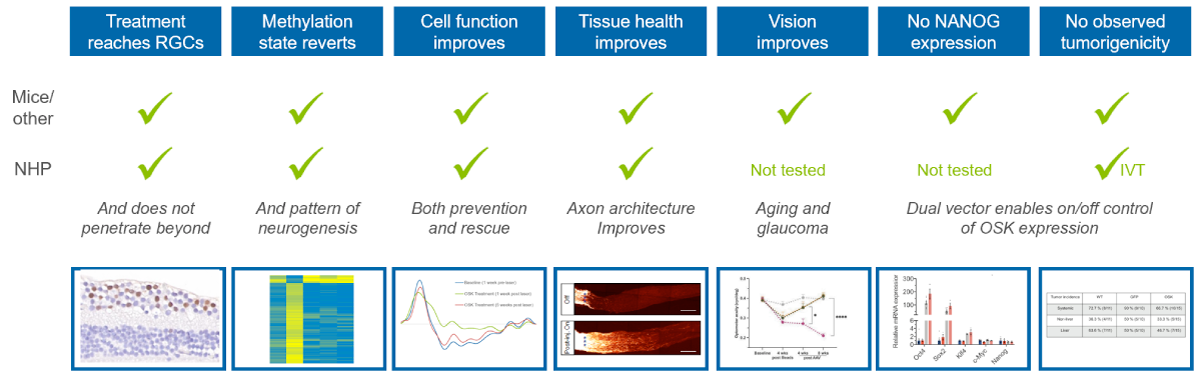
Image credit: Life Biosciences
In early studies in animals, this approach was associated with improvements in cellular function, nerve structure, and measures of vision. The ongoing Phase 1 trial is designed to test whether this effect can be safely achieved in humans with open-angle glaucoma and non-arteritic anterior ischemic optic neuropathy, where there are currently no treatments that directly repair or regenerate ganglion cells.
From Proxy Diseases to Aging Itself
Life Bio's Phase 1 sits within a longevity field that has considerably shifted in recent years. What began largely as biohacker enthusiasm and theoretical geroscience has consolidated into a funded, if still early-stage, drug development sector—one where companies are increasingly forced to pick specific diseases, design real endpoints, and navigate regulatory paths that weren't built for "aging" as an indication.
See also: Aging, AI, and the Uneven Road to Longevity Medicine
Companies enter through age-related proxy diseases that offer validated endpoints, then position their platforms for broader aging applications later. Life Bio chose optic neuropathies. Retro Biosciences is routing its autophagy work through Alzheimer's. Insilico Medicine's TNIK inhibitor advanced through idiopathic pulmonary fibrosis. Even the dog longevity programs (Loyal's LOY-002, now in FDA review) serve partly as a faster regulatory path to test an explicit lifespan-extension claim.
Whether any of these bets produce a credible shift in aging biomarkers alongside disease-specific efficacy remains to be seen. Besides capital, progress depends on better inputs like earlier longitudinal measurement, genuinely representative cohorts, and clearer separation of which mechanisms are causal drivers of aging versus downstream effects. That groundwork will shape whether longevity medicine delivers something structurally new or mainly repackages conventional drug development under a younger banner.
Topic: Biotech Ventures