Ultima Genomics Launches Faster DNA Sequencers with Higher Output
Almost exactly a year since releasing UG100, Ultima Genomics has launched a new line of DNA sequencing systems, the UG200 Series, together with updated Solaris 2.0 workflows.
The changes focus on three areas: producing more sequencing data per run, shortening the time required to complete a run, and adjusting the chemistry used to copy DNA so that difficult regions of the genome are covered more evenly. The new instruments are expected to begin shipping in the second quarter of 2026, while the updated workflows are available immediately.
Ultima Genomics plans to present the UG200 Series and Solaris 2.0 workflows at the Advances in Genome Biology and Technology conference on February 25, 2026.
The UG200 Series includes two configurations: a single-wafer (in this context, a wafer is a large surface that holds billions of DNA fragments for sequencing; more wafers generally mean more data per run) UG200 system priced from $850,000 and a dual-wafer UG200 Ultra priced at $1.25 million.
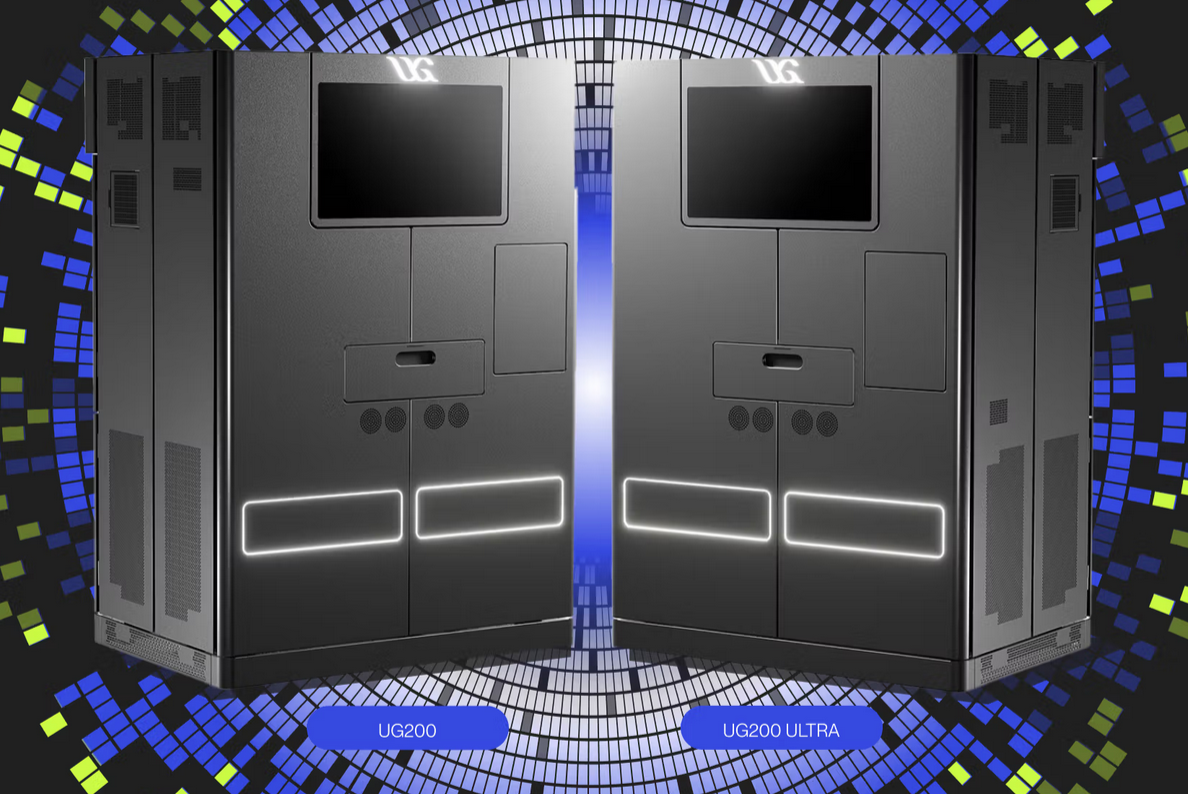
Image credit: Ultima Genomics
Ultima reports that the UG200 Series delivers up to twice the output of the earlier UG100 platform while reducing runtime by roughly half and shrinking the system footprint. With the forthcoming Solaris 2.0 Max chemistry, expected in the second half of 2026, each wafer may generate up to 20 billion reads, short DNA sequences that are later assembled into full genomes.
The dual-wafer UG200 Ultra is designed to process more than 60,000 human genomes per year, while the single-wafer system supports about 30,000. The platform is built for continuous operation, with automated queueing of up to 10 wafers.
The UG200 Series was previously offered through an early access program and is now commercially available, with shipments scheduled to begin in the second quarter of 2026.
Solaris 2.0 & Solaris 2.0 Max
The Solaris 2.0 workflows modify how DNA fragments are amplified before sequencing. Amplification is the step where each DNA fragment is copied many times to generate enough signal for detection. In earlier setups, this required a separate emulsion PCR instrument. The new method removes the need for that separate device, simplifying the workflow, allowing amplification to be performed directly on standard liquid-handling robots.
Ultima states that the updated chemistry improves coverage uniformity. Coverage refers to how evenly different parts of the genome are read. Some genomic regions, especially those that are repetitive or structurally complex, are historically harder to sequence accurately.
A higher-output chemistry, Solaris 2.0 Max, is planned to deliver up to 20 billion reads per wafer. Additional 10-billion and 5-billion wafer options are intended to allow labs to scale output depending on project size and budget. Paired-end sequencing, where both ends of each DNA fragment are read to improve mapping accuracy, is also planned for the UG200 Series.
Existing UG 100 instruments can be upgraded in the field to a configuration called UG100 Plus. The company reports that with Solaris 2.0 Max, upgraded systems could approach four times the annual output compared with the original UG 100 setup at its initial launch; the workflows are available now.
Topic: Next-Gen Tools