Tempus and Merck Deepen AI Collaboration to Study Cancer Biomarkers
Tempus AI (NASDAQ: TEM) and Merck have signed an expanded multi-year collaboration to apply AI to large multimodal clinical datasets for biomarker discovery and oncology research. Through the agreement, Merck gains access to Tempus’ data infrastructure and computing environment to support oncology discovery programs.
The collaboration will focus initially on oncology programs. Merck plans to use the platform to identify precision medicine biomarkers, investigate mechanisms of cancer resistance, and explore rational drug combinations across candidates in its early-stage pipeline. The partners indicated that the scope could later expand into additional therapeutic areas.
Under the agreement, Merck will use Tempus’ de-identified multimodal data resources together with the company’s Lens platform and Workspaces computational environment.
Tempus Lens is a research platform designed to allow scientists to find, access, and analyze Tempus’ de-identified multimodal clinical and molecular datasets. It enables users to build patient cohorts using clinical and genomic filters or natural-language queries through an AI assistant, run no-code analyses and visualizations, and perform deeper custom analyses in a cloud environment using tools such as R or Jupyter notebooks.
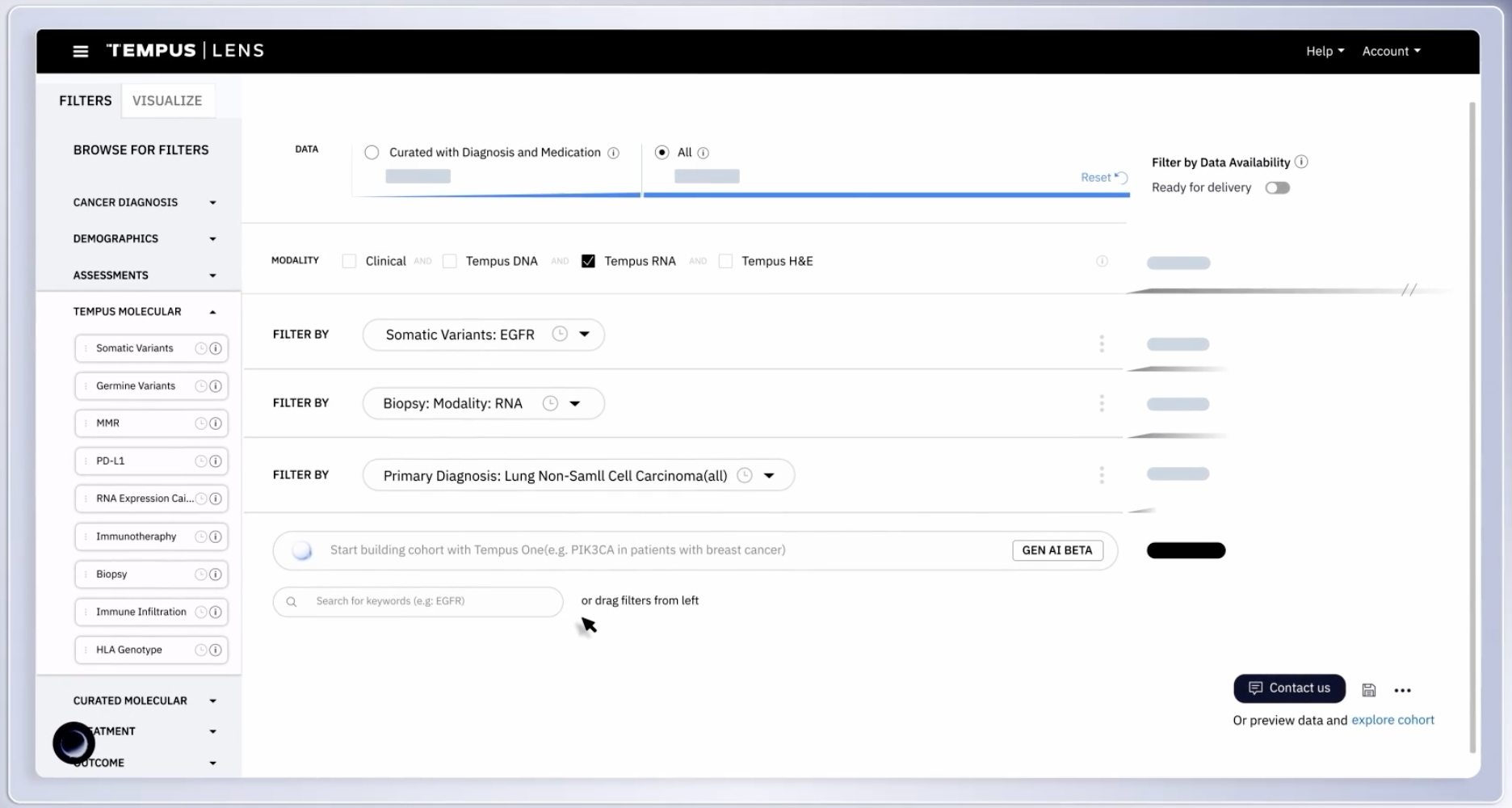
Image credit: Tempus AI
The platform integrates curated real-world data with computational infrastructure so researchers can examine biomarker prevalence, treatment patterns, outcomes, and other clinical signals directly within the same environment.
Recently, Tempus AI expanded its precision medicine infrastructure through several acquisitions and product launches. In 2025, the company acquired clinical trial matching platform Deep 6 AI, adding a network of more than 750 healthcare provider sites and access to data from over 30 million patients.
Tempus has also extended its diagnostics capabilities with the launch of Paige Predict, an AI-based digital pathology system that analyzes standard H&E tissue slides to estimate the likelihood of biomarker presence in 16 cancer types, and entered a multi-year collaboration with AstraZeneca and Pathos AI to develop a large multimodal foundation model for oncology, trained on Tempus’ de-identified clinical and molecular datasets.
Merck isn't the only big pharma leveraging Tempus’ AI capabilities.
- AstraZeneca has embedded Tempus data, analytics tools, and AI workflows across its oncology R&D governance process after initial pilot collaborations, using the platform to support clinical trial design and patient stratification.
- Pfizer has worked with Tempus to analyze HER2 biomarker expression across multiple solid tumors using the company’s multimodal clinical and transcriptomic datasets, helping explore potential new patient populations for HER2-targeted therapies.
- Bristol Myers Squibb has partnered with Tempus on multimodal AI research aimed at identifying and validating new oncology drug targets using patient data and organoid disease models.
- Takeda has also expanded its collaboration with Tempus to apply real-world multimodal datasets, the Lens analytics platform, and patient-derived tumor organoids to guide oncology drug development, including evaluation of antibody-drug conjugates, small molecules, and cell-based therapies.
- GSK has committed at least $70 million to access Tempus’ AI-enabled patient data platform to improve oncology trial design and enrollment, alongside collaborative studies.
- Boehringer Ingelheim has also entered a multi-year collaboration with Tempus to use its multimodal real-world data and Lens analytics platform to support biomarker discovery, patient stratification, and oncology portfolio decisions.
- Eli Lilly sponsors Tempus-run genomic testing programs in lung and thyroid cancer, using Tempus assays and data infrastructure to broaden biomarker testing and inform trial enrollment.
Topic: Industry Movers