BioPharmaTrend
Latest Insights
Companies
  • Companies Directory
  • Case Studies
Newsletter
About
  • At a Glance
  • Our Team
  • Advisory Board
  • Citations and Press Coverage
  • Partner Events Calendar
  • Advertise with Us
 
 Subscribe 
Sign in
  • AI in Bio
  • Tech Giants
  • Next-Gen Tools
  • Business Intelligence

  News

Pusan National University Researchers Develop AI Model to Identify Therapeutic Gene Targets Using Hypergraphs

by BiopharmaTrend   •   May 26, 2025

Disclaimer: All opinions expressed by Contributors are their own and do not represent those of their employers, or BiopharmaTrend.com.
Contributors are fully responsible for assuring they own any required copyright for any content they submit to BiopharmaTrend.com. This website and its owners shall not be liable for neither information and content submitted for publication by Contributors, nor its accuracy.

Share:   Share in LinkedIn  Share in Bluesky  Share in Reddit  Share in Hacker News  Share in X  Share in Facebook

A team from Pusan National University, led by Associate Professor Giltae Song, has developed a new artificial intelligence model called the Hypergraph Interaction Transformer (HIT) to improve the identification of therapeutic gene targets. 

The research was published in Briefings in Bioinformatics (January 2025, Vol. 26, Issue 1).

Unlike conventional deep learning models that struggle to capture the complex many-to-many relationships between diseases, genes, and ontologies, HIT uses hypergraph structures and attention-based encoders to represent these associations more effectively. The model constructs separate gene and disease hypergraphs from biological datasets and processes them using a two-stage encoding system to classify genes as therapeutic targets, biomarkers, or unrelated.
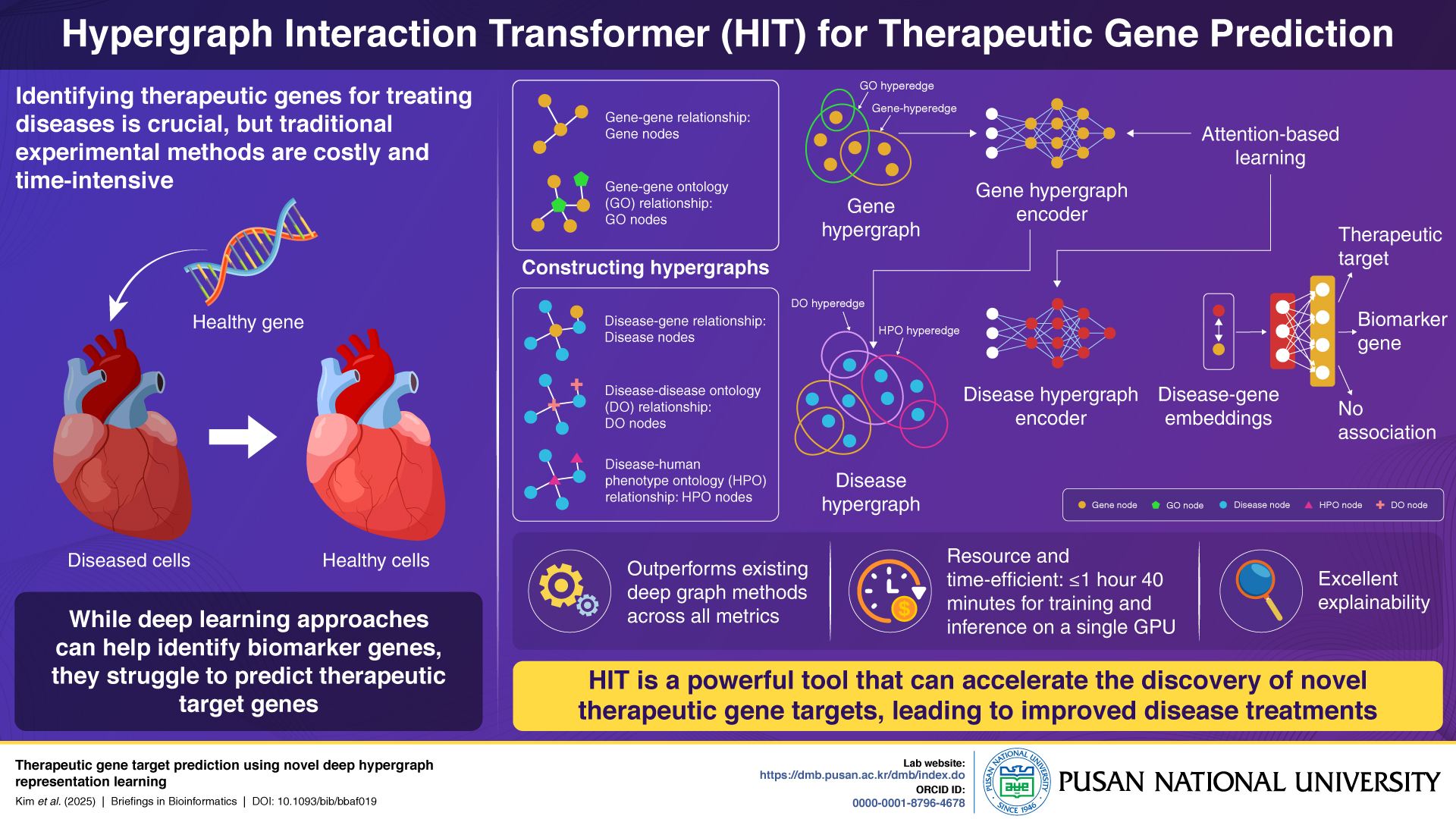
In benchmark testing, HIT outperformed all existing models across evaluation metrics and required only 1 hour and 40 minutes of GPU-based training and inference time. A case study on heart failure showed the model successfully identified all known therapeutic targets. The researchers emphasize HIT’s explainability as a key feature, enabling transparency in how gene-disease associations are determined—critical for clinical and translational research.

The model is intended to shorten the drug development pipeline and enhance the precision of early-stage therapeutic research, particularly in the context of personalized medicine.


Share:   Share in LinkedIn  Share in Bluesky  Share in Reddit  Share in Hacker News  Share in X  Share in Facebook

BiopharmaTrend.com

Where Tech Meets Bio
mail  Newsletter
in  LinkedIn
x  X
rss  RSS Feed

About


  • What we do
  • Press & Citations
  • Terms of Use
  • Privacy Policy
  • Cookies Policy
  • Disclaimer

Topics


  • News
  • AI in Bio
  • Tech Giants
  • Next-Gen Tools

Explore


  • Premium Insights
  • Business Intelligence
  • Companies
  • Events
  • Authors

Partner


  • Sponsorship
  • Editorial Calendar

© WTMB Research & Media, S.L. (WTMB Group)   2026
We use cookies to personalise content and to analyse our traffic. You consent to our cookies if you continue to use our website. Read more details in our cookies policy.