Liquid AI and Insilico Release Lightweight On-Premise AI Model for Drug Discovery
Liquid AI and Insilico Medicine have released LFM2-2.6B-MMAI, a general small AI foundation model trained into a system intended to support multiple stages of drug discovery while allowing companies to keep their data inside their own computing environments without transmitting it to external cloud services.
The 2.6-billion-parameter scientific foundation model is designed to run on private pharmaceutical infrastructure and was trained with Insilico Medicine’s recently launched Science MMAI Gym training framework, a framework that helps turn general LLM models into specialized biomedical and chemical tools.
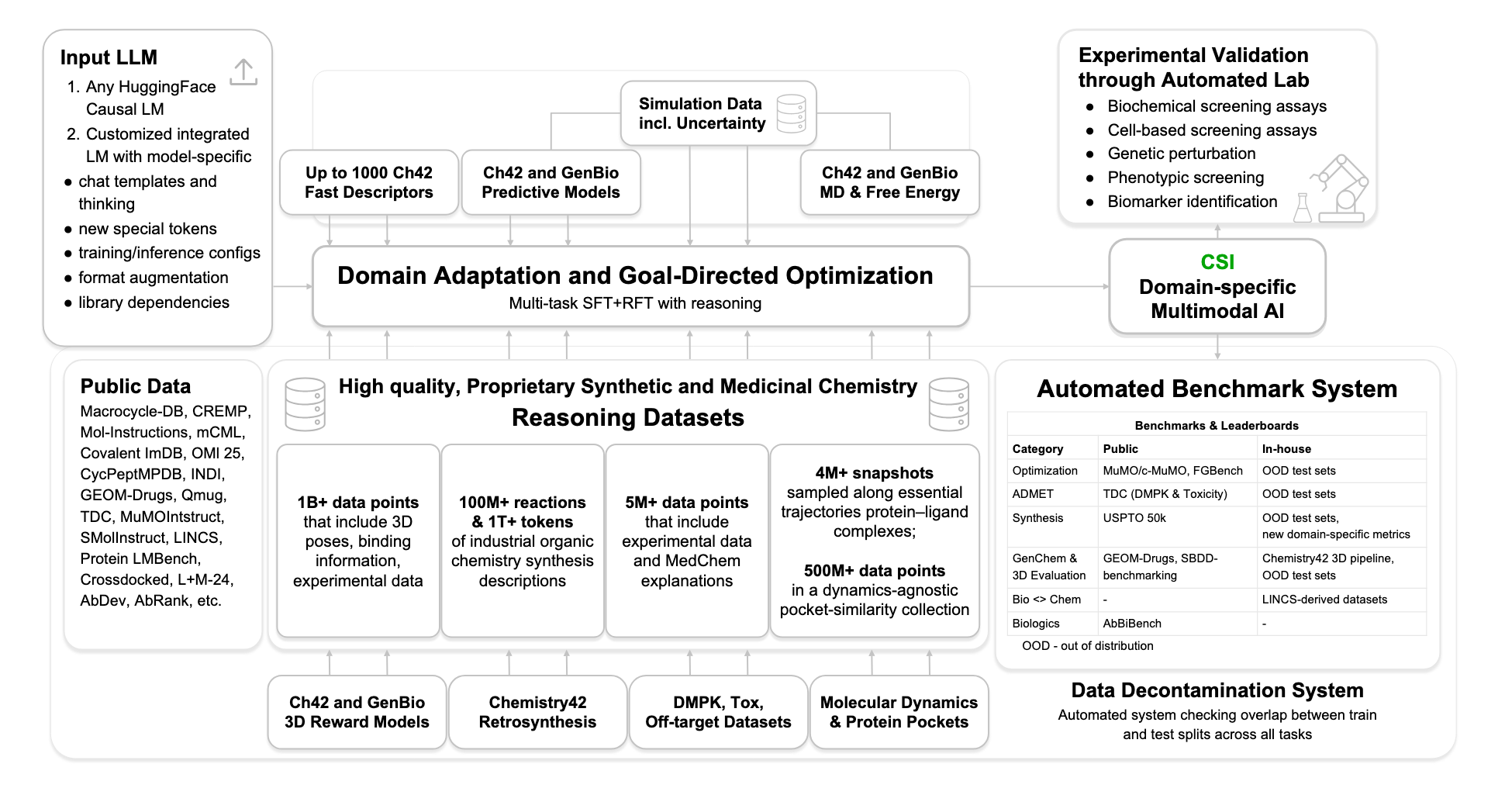
Image credit: MMAI Gym for Science: Training Liquid Foundation Models for Drug Discovery, Figure 2, MMAI Gym: Integrated Data, Training, and Benchmark Suite
In Science MMAI Gym, LFM2-2.6B-MMAI was trained using supervised fine-tuning (SFT), reasoning fine-tuning (RFT), and reinforcement learning (RL) guided by proprietary reward models.
According to the developers, the goal was to encode chemical and physical constraints of molecular systems so the model can reason about drug-like molecules. Research teams can request access to deploy LFM2-2.6B-MMAI within their environments.
The developers state that the model is designed to support tasks across the drug discovery workflow, including ADMET prediction, molecular property estimation, retrosynthesis planning, and multi-parameter molecular optimization.
Liquid AI, founded by researchers from MIT, develops Liquid Foundation Models (LFMs), a family of relatively small and compute-efficient open source AI models designed to run on a wide range of hardware, including laptops, servers, mobile devices, and specialized chips.
Instead of relying on extremely large cloud-based models, LFMs use an architecture optimized for speed and efficiency, allowing organizations to deploy AI locally or on private infrastructure. The lineup includes text models, vision-language models that process images and text together, audio models for speech interaction, and smaller “nano” models tuned for specific tasks such as data extraction, search, translation, or retrieval-augmented generation.
Insilico Medicine, a biotechnology company focused on AI-driven drug discovery, has previously reported several AI-designed drug candidates entering clinical development, including ISM8969, an NLRP3 inhibitor that recently received FDA clearance to begin Phase I trials, and gut-restricted PHD inhibitor ISM5411 in Phase II IBD trial.
See also: Insilico Medicine Reports Benchmarks for its AI-Designed Therapeutics
About LFM2-2.6B-MMAI
Training data reportedly included around 120 billion tokens derived from Insilico’s internal datasets, covering more than one billion molecular and experimental data points, including protein–ligand binding information, 3D structural poses, over 100 million chemical reactions, and roughly five million medicinal chemistry experimental measurements.
In benchmarking tests reported by the companies, the model outperformed TxGemma-27B on 13 of 22 molecular property prediction tasks related to pharmacokinetics and toxicology.
On Insilico’s internal affinity prediction benchmark, which includes 2.5 million experimental measurements across 689 protein targets, the model reportedly achieved higher correlation scores than several larger general-purpose systems including GPT-5.1, Claude Opus 4.5, and Grok-4.1.
In multi-objective optimization tests on the MuMO-Instruct benchmark, the model reportedly achieved a high success rate in generating candidate molecules satisfying multiple design constraints.
A full technical report is available in the whitepaper.
Topic: AI in Bio