Latent Labs Launches AI Agent for Antibody Design From a Single Text Prompt
After emerging from stealth with a $50 million seed round last year, Latent Labs presents Latent-Y, an AI system that can generate antibody candidates directly from written research goals, reportedly moving from concept to lab-tested molecules within hours, with a subsequent technical report (pdf). The system is designed to increase the number of design programs a single researcher can run, with initial validation showing binding activity across multiple biological targets.
Latent Labs is an AI research company focused on building generative models for biology, with the aim of making molecular design more programmable and scalable. Alongside Latent-Y, the company has developed Latent-X, a model for designing protein binders at the atomic level. The team brings experience from DeepMind’s AlphaFold program—CEO Simon Kohl co-developed AlphaFold 2 and later led protein design efforts, while founding engineer Alex Bridgland worked across AlphaFold 1, 2, and 3. The company operates between London and San Francisco.
Latent-Y can carry out end-to-end antibody discovery workflows starting from text prompts. The system interprets high-level research objectives: target biology, mechanism of action, or binding constraints; and translates them into candidate molecules ready for experimental testing without requiring manual setup across multiple computational tools.
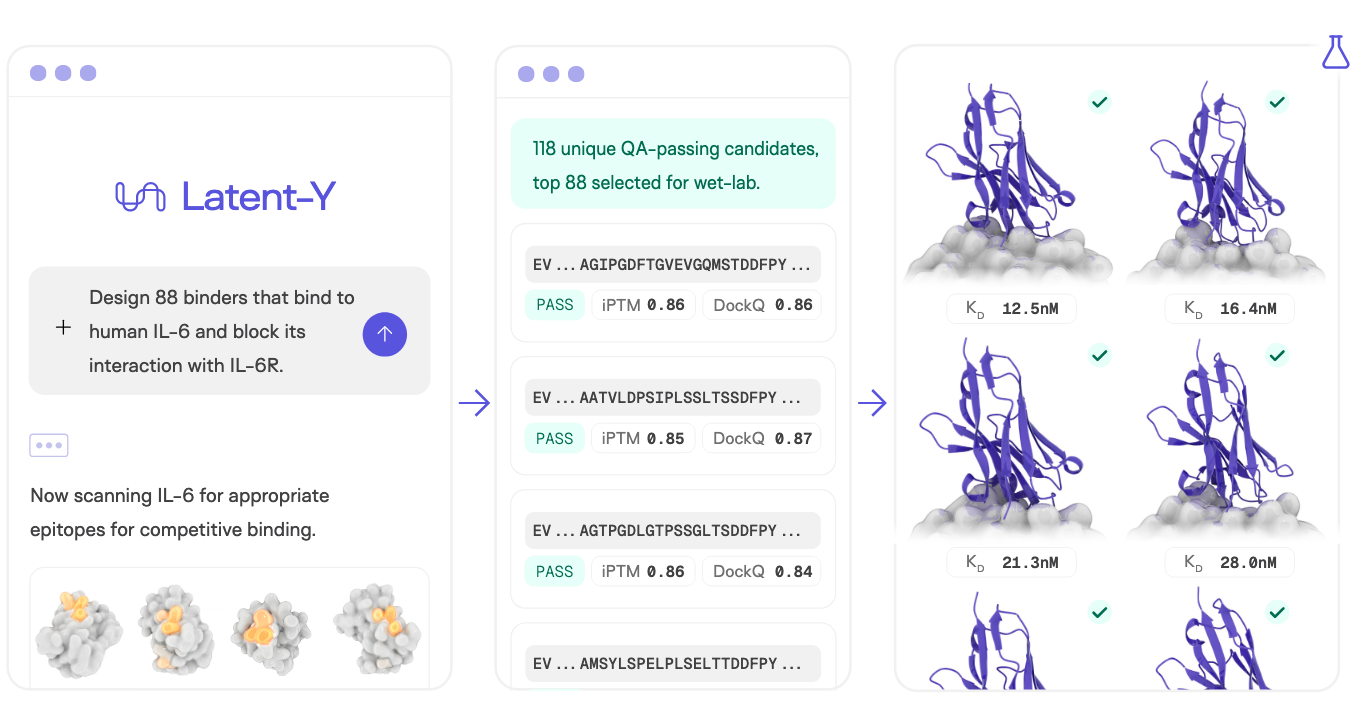
Image credit: Latent-Y: A Lab-Validated Autonomous Agent for De Novo Drug Design (pdf)
How the System Works
At the core of the system is a generative model, Latent-X2, which produces antibody sequences with predicted structural and biochemical properties. Latent-Y adds a reasoning layer on top of this model, allowing it to plan and execute multi-step design campaigns.
The system operates in an environment similar to that used by protein design researchers, with access to databases, modeling tools, and scientific literature. It can also process external inputs such as research papers, extracting relevant biological context and using it to guide design decisions. In one example, the agent analyzed a publication describing transport across the blood–brain barrier and generated antibodies targeting a relevant receptor, which were later confirmed experimentally. Further details can be found in the Latent-Y technical report (pdf).
Parallel Design Capacity
A key aspect of the system is its ability to run multiple design campaigns in parallel. According to internal user studies, researchers using the platform completed design workflows up to 56 times faster than estimated timelines for manual computational work. This parallelism allows exploration of more targets and design strategies within the same timeframe, which is often a constraint in early drug discovery.
The system can operate autonomously or in a stepwise mode where researchers review intermediate outputs. Each design decision is recorded, allowing users to inspect how the agent arrived at a given candidate. This transparency is intended to keep human oversight in workflows that would otherwise be automated.
Capabilities
As described in the technical report (pdf), across nine design campaigns covering different types of tasks, Latent-Y produced lab-confirmed binders for six targets. These included scenarios such as identifying new binding sites based on functional requirements, designing molecules that bind to related proteins across species, and generating candidates from published scientific data. Reported binding affinities reached the low nanomolar range, which is typically associated with strong molecular interactions in early-stage discovery.
Latent-Y currently supports multiple molecular formats, including nanobodies, peptides, and small protein binders. The company indicates that future development may involve tighter integration with experimental systems, including automated laboratories, to create closed-loop workflows where computational design and lab validation continuously inform each other.
All reported results are at the preclinical stage. Further validation, including animal studies and clinical testing, would be required to assess how these computationally designed molecules perform in therapeutic settings.
Cover image credit Latent-Y: A Lab-Validated Autonomous Agent for De Novo Drug Design (pdf)
Topic: AI in Bio