Ginkgo Opens Its Robot Lab to Researchers Through a Web Browser
Ginkgo Bioworks has introduced Ginkgo Cloud Lab, an AI-powered interface that allows scientists to submit experimental protocols through a website and run them on Ginkgo’s internal automated lab in Boston. The platform is built around the company’s Reconfigurable Automation Carts (RACs) and integrates more than 70 laboratory instruments.
RACs are modular lab automation units built to handle changing, high-mix workflows, like liquid handling, sample preparation, analytical measurement, storage, and incubation. Each cart combines a dedicated robotic arm, a plate transport track, and standardized connection points so instruments from different vendors can be arranged as needed.
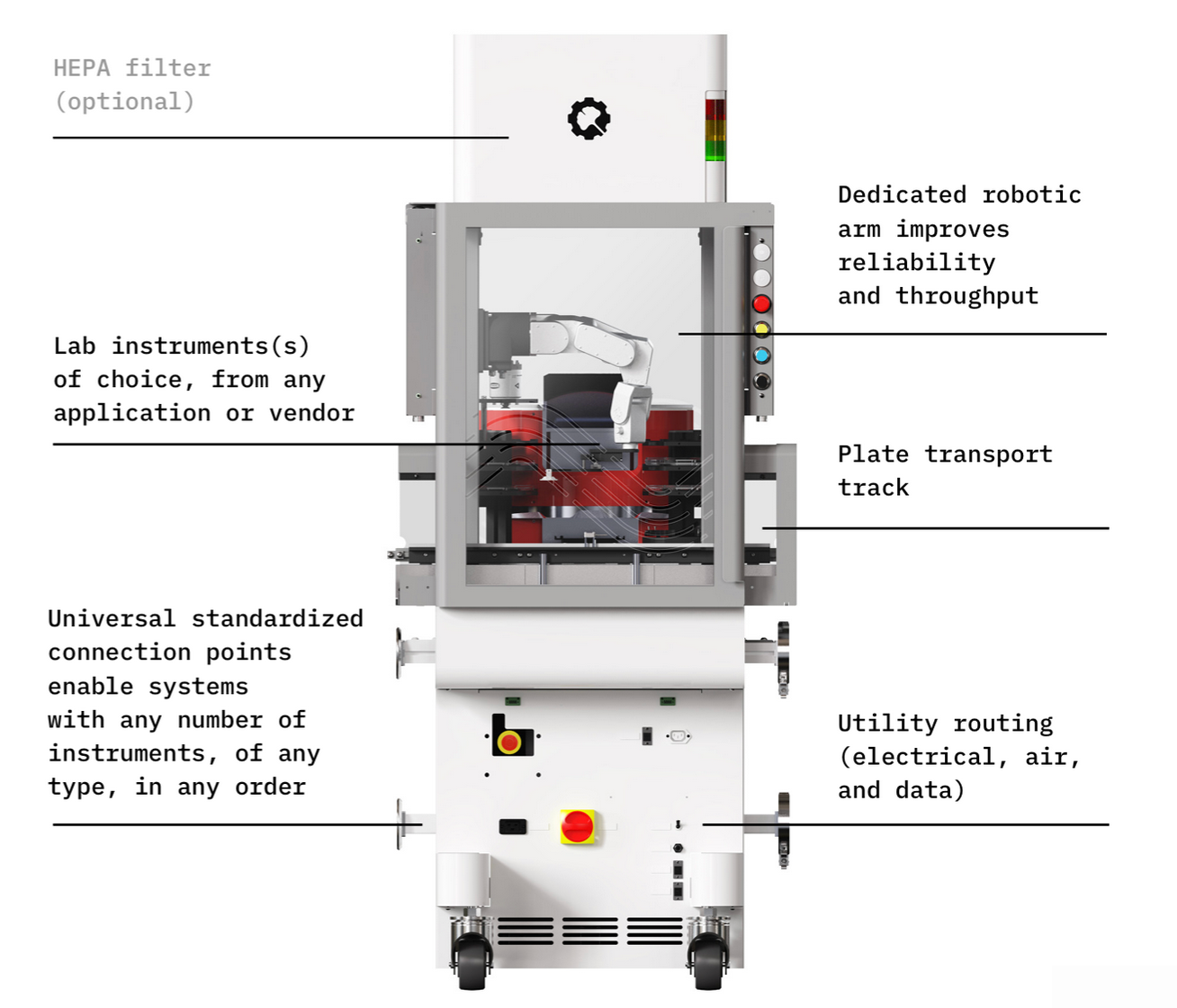
Image credit: Reconfigurable Automation Carts (RACs), Ginkgo Bioworks
Utilities such as power, air, and data are integrated into the system, with optional HEPA filtration for controlled environments. The design allows labs to scale or reconfigure setups without rebuilding the entire workflow from scratch.
An AI-based agent, EstiMate, is at the core of Ginkgo Cloud Lab. It interprets protocols written in natural language and evaluates whether a proposed workflow can be executed using the current autonomous infrastructure, then provides a cost estimate.
Cloud Lab is now open to researchers across academia and biopharmaceutical companies, and Ginkgo is inviting submission of protocols for evaluation and execution through the interface.
Nebula, Ginkgo’s Boston-based autonomous lab, houses Cloud Lab as part of the company’s broader plan to consolidate R&D operations and phase out traditional bench-based workflows.
Earlier in 2025, Ginkgo’s Datapoints unit teamed up with Inductive Bio and Tangible Scientific to link AI-based ADMET predictions directly with automated lab testing and compound logistics, creating a closed design–test–learn loop for small-molecule drug discovery.
Such setups where computational models propose experiments, robotic platforms execute them, and the resulting data feeds back into model refinement, creating iterative design–test–learn cycles, is gaining traction across biotech as companies seek to reduce manual variability.
Recent examples include Outpost Bio’s $3.5 million pre-seed round to build a lab-in-the-loop microbiome platform that pairs automated experimentation with machine learning models, and Turbine’s expansion of its AI-driven digital cell system into immunology through iterative wet-lab validation.
Across big tech & big pharma, Thermo Fisher’s has collaborated with NVIDIA and TetraScience to embed AI infrastructure directly into laboratory instruments, and platforms linking ADMET prediction with automated assay execution to create closed design–test–learn workflows, and Eli Lilly, together with NVIDIA, are planning to open an AI co-innovation hub in San Francisco.
Topic: AI in Bio