FDA Clears AI That Flags Early Stroke Damage on Routine Brain CT Scans
CT Brain, an AI system developed by Harrison.ai, has received FDA 510(k) clearance to automatically flag signs of acute brain infarction on standard non-contrast CT scans. During a stroke, brain cells begin to die within minutes when blood flow is blocked. CT Brain helps doctors review urgent cases sooner so treatment can start faster.
The approval adds another indication to Harrison.ai’s radiology software portfolio and marks the company’s second product with FDA Breakthrough Device designation to reach market authorization, the first one being AI-powered chest X-ray triage solution, Annalise Enterprise CXR in 2022.
Notably, in October 2025, Harrison.ai petitioned the U.S. FDA to allow certain radiology AI computer-aided detection devices to bypass the standard 510(k) premarket review process and instead rely more on post-market monitoring, a proposal currently under FDA review that has drawn both support from some AI vendors and opposition from major radiology and patient-safety groups.
About CT Brain
In hospital stroke workflows, a non-contrast CT scan is typically the first imaging test performed when a patient arrives with possible stroke symptoms. However, early ischemic strokes are often difficult to see on this scan because the damage to brain tissue may be subtle.
CT Brain reviews routine head CT scans and automatically alerts clinicians if it detects signs of an acute brain infarction, the type of tissue damage caused by an ischemic stroke. The system functions as a triage tool, meaning it does not diagnose stroke on its own but helps move potentially urgent cases to the top of the reading queue.
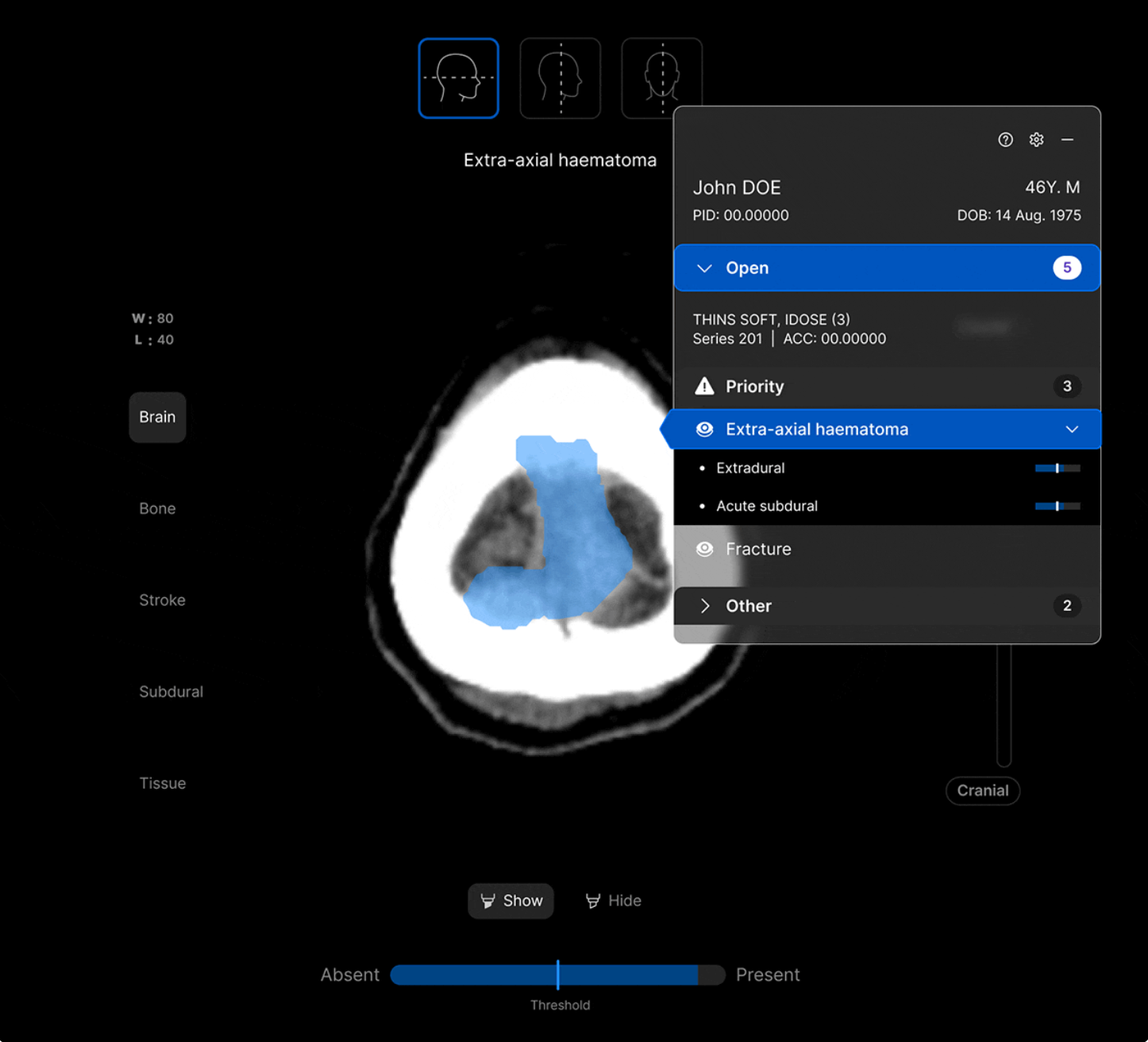
Image credit: Harrison.ai
Because the non-contrast CT scan is performed immediately when stroke is suspected, a triage system operating on that scan could potentially:
- flag subtle early infarcts that radiologists might miss initially
- prioritize those scans for faster review
- accelerate follow-up imaging such as CTA or MRI
This is particularly relevant for patients who arrive without a dedicated stroke protocol, where infarcts may otherwise be identified later in the imaging workflow.
How can AI recognize stroke
Many existing AI stroke tools analyze CT angiography (CTA) scans, which are performed later in the diagnostic process and require injection of contrast dye to visualize blood vessels. Those systems typically detect large vessel occlusions (LVOs)—major blockages in large brain arteries.
CT Brain instead analyzes the earliest scan in the workflow and looks for actual tissue damage in the brain, not just blocked vessels.
The company says the software can identify infarcts across six vascular territories of the brain, including:
- anterior cerebral artery (ACA)
- middle cerebral artery (MCA)
- posterior cerebral artery (PCA)
- cerebellar regions
- basilar artery territory
- watershed infarcts
The goal is to catch strokes that might not involve a large vessel blockage and could otherwise be missed or delayed.
Harrison.ai is a healthcare technology company founded by Dr. Aengus Tran and Dimitry Tran that develops artificial intelligence software to support clinical decision-making in radiology and pathology. The company builds AI tools that analyze medical images and help clinicians identify abnormalities, prioritize urgent cases, and streamline diagnostic workflows. The company says its radiology AI software is deployed at more than 1,000 clinical sites across over 40 countries.
Topic: AI in Bio