Ex-Neuralink Founder Raises $290M to Restore Vision With a Rice Grain-Sized Retinal Implant
Alameda-based Science Corporation has raised $230 million in Series C financing from investors including Lightspeed Venture Partners, Khosla Ventures, Y Combinator, IQT, and Quiet Capital to support commercialization of its PRIMA retinal brain-computer interface (BCI) implant and to expand clinical trials into additional retinal diseases.
The funding brings the company’s total capital raised to $490 million since its founding in 2021 and will be used to scale manufacturing, research, and clinical operations as the device approaches market launch in Europe and USA.
Brain-computer interface companies have attracted growing investment in recent years as the field moves from academic prototypes toward clinical devices. For broader context, see our yearly review Neurotech Trends in 2025: When Use Cases Started Driving Design.
PRIMA is a 2x2 mm retinal implant containing 378 light-powered pixels designed to restore partial vision in patients who have lost photoreceptor function due to degenerative eye diseases. The implant replaces damaged photoreceptors by converting visual signals into electrical patterns that can be interpreted by the visual system.
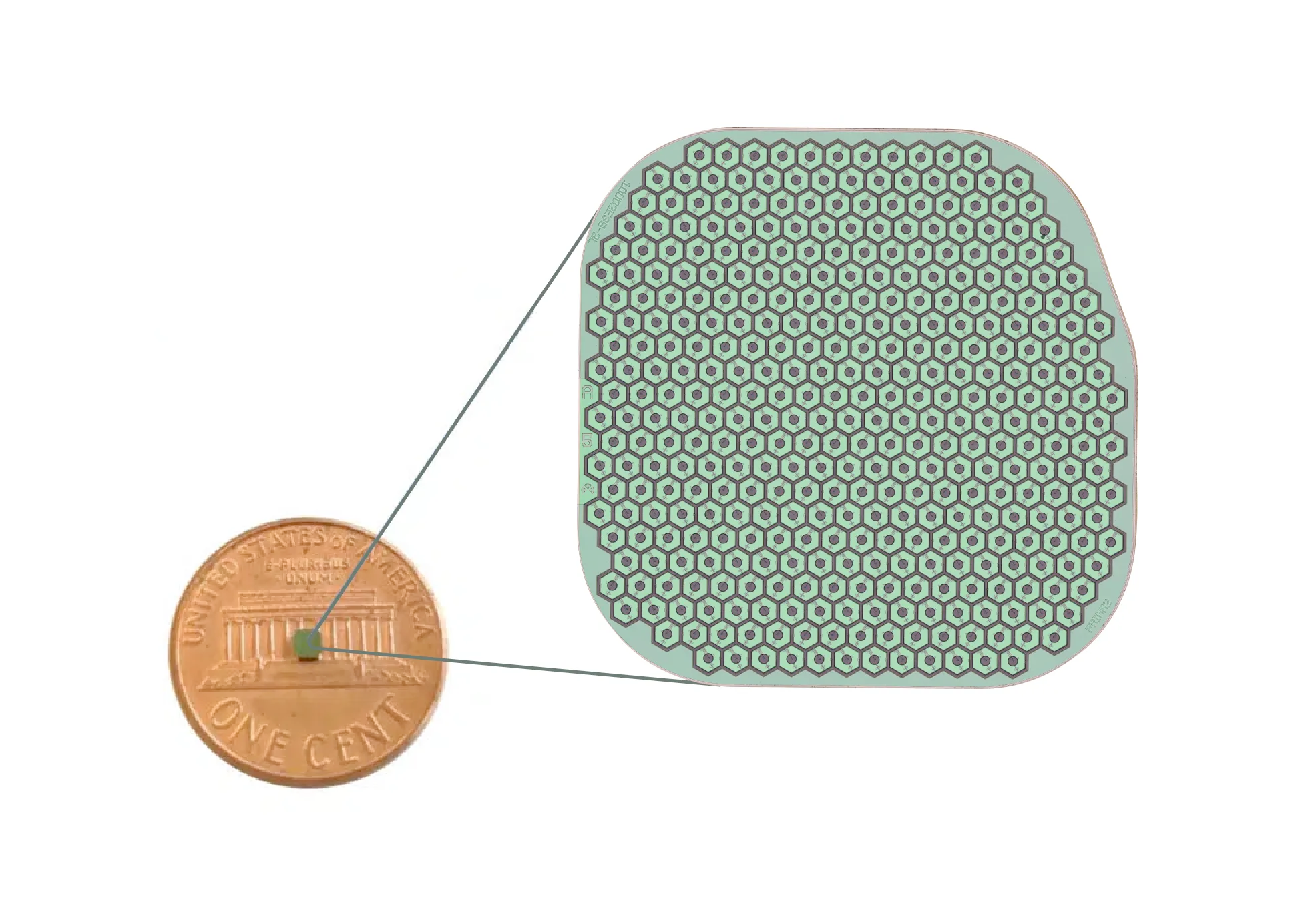
Image credit: PRIMA Visual Prosthesis, Science Corporation
A pair of external glasses captures visual scenes with a camera and converts them into patterns of infrared light that are projected into the eye. The implant’s pixels act as tiny photovoltaic stimulators: when illuminated, each pixel converts the infrared light into electrical signals that activate nearby retinal cells. In this way, the glasses provide both power and visual information to the implant, while a pocket processor adjusts parameters such as zoom and brightness.
See also: 10 Companies Shaping the Brain-Computer Interface Landscape: Invasive vs Non-Invasive BCI Technology
Clinical results reported in The New England Journal of Medicine peer-reviewed study evaluated the PRIMA system in 38 patients with advanced dry age-related macular degeneration, a condition that destroys photoreceptors in the central retina.
According to the study, about 80% of participants showed measurable improvement in visual acuity and were able to recognize letters, numbers, or words using the implant-assisted system.
Beyond macular degeneration, the company is expanding the PRIMA clinical program to include inherited retinal disorders such as Stargardt disease and retinitis pigmentosa, which are leading causes of genetic vision loss. The upcoming trial will be conducted at Sydney Eye Hospital in Australia under the direction of retinal specialist Dr. Matthew Simunovic.
Science Corporation was founded in 2021 by Max Hodak, previously a co-founder of Neuralink, and focuses on building implantable neural interfaces intended to restore lost sensory or neurological function.
The new funding will also support development of Science Corporation’s broader neural engineering technologies:
- Biohybrid neural interface is an experimental brain-computer interface architecture that integrates living neurons into an electronic device so the device can connect to the brain through biological synapses rather than metal electrodes alone. The approach is intended to increase communication bandwidth between implants and neural circuits while reducing tissue damage, since neurons can integrate into the dense neural network of the brain more naturally than large numbers of implanted wires.
- Vessel is a modular life-support perfusion system designed to circulate and oxygenate blood outside the body for extended periods. It routes blood through modules that act like artificial lungs, pumps, and kidneys to control oxygenation, pressure, temperature, and blood chemistry. Built-in sensors and closed-loop automation monitor these parameters in real time and adjust the system automatically, aiming to enable longer-term perfusion while reducing the intensive manual oversight required by current ICU systems.
Additionally, Science Corporation operates a neural engineering Science Ecosystem, which is a modular platform for building and operating brain-computer interfaces.
It organizes BCI systems into three main components: probes that interface with brain tissue to record or stimulate neural activity, adapters that transmit power and data, and headstages that perform low-latency signal processing and computing.
These components are connected through Synapse OS, a software layer that manages neural data streams, hardware control, and real-time processing. The platform is designed so researchers and device developers can mix and match probes, software models, and hardware modules, and use the company’s engineering and fabrication infrastructure to build and test new neural interface systems.
Topic: Biotech Ventures