Earendil Labs Gets $787M to Push AI-Designed Antibodies Toward the Clinic
Earendil Labs has secured $787 million in financing to expand its AI-based biologics discovery and development platform, with backing from investors including Dimension Capital, DST Global Partners, Sanofi, and a biotech fund formed by Hillhouse and Pfizer. The funding is intended to support pipeline expansion, team growth, and advancement of multiple antibody programs toward clinical stages.
The Wilmington-based company considers artificial intelligence a central component of its R&D infrastructure, applied across target discovery, molecule design, and preclinical development. The company operates alongside its affiliate Helixon Therapeutics, which contributes to platform development and pipeline execution.
Earendil Labs’ AI suite includes:
- Foundational AI model for protein and antibody design — trained to work across sequence, structure, and interaction data, it predicts how antibodies bind targets, identifies binding sites, and supports design changes. It can also estimate properties like stability, immunogenicity, and half-life, helping prioritize candidates before lab testing.
- Integrated AI + lab platform for generating and testing biologics — combines model outputs with high-throughput experiments to create antibody libraries, screen for binding and function, and refine leads. The system supports iterative design cycles and downstream steps such as production, characterization, and formulation.
See also: What are Foundation Models in Biology and Healthcare?
With the help of its AI-native platform, the company reports it has generated more than 40 therapeutic programs to date. Earendil Labs is building a pipeline of antibody-based therapies focused on immune and inflammatory diseases, including inflammatory bowel disease, asthma, COPD, atopic dermatitis, and B-cell–related conditions, alongside a separate set of oncology programs targeting colorectal cancer, small-cell lung cancer, and other solid tumors.
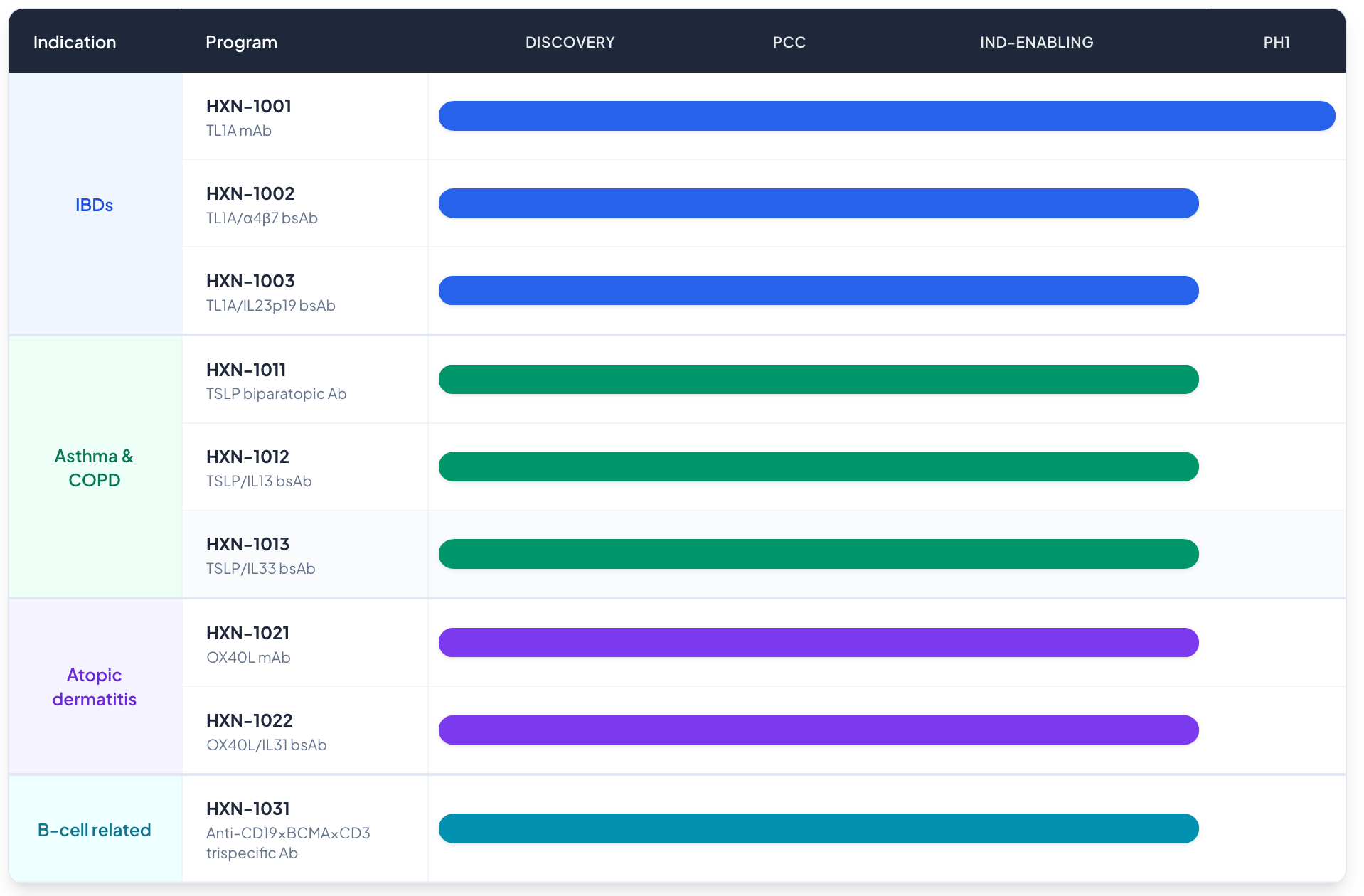
Image credit: Earendil Labs’ pipeline
Among the company’s AI-designed therapeutic programs, HXN-1001 is a half-life extended anti-TL1A antibody designed for inflammatory bowel disease (IBDs), and is described as ready for Phase 2 clinical development. Earendil also plans multiple Investigational New Drug (IND) submissions across 2026 and 2027.
HXN-1001 targets tumor necrosis factor (TNF)-like cytokine 1A (TL1A), an immune signaling protein that has become a closely watched target in inflammatory bowel disease. It appears to drive both gut inflammation and tissue scarring, which makes it attractive as a drug target in ulcerative colitis and Crohn’s disease.
Earendil is not alone in that race: Sanofi and Teva’s anti-TL1A antibody duvakitug is already in phase 3 for both diseases, following phase 2b data they said showed durable efficacy, while Merck has said its anti-TL1A antibody tulisokibart is also in phase 3 for ulcerative colitis and Crohn’s disease, alongside three other diseases currently in phase 2b.
In 2025, Earendil Labs received $125 million upfront through a worldwide exclusive licensing agreement with Sanofi covering bispecific antibody programs HXN-1002 and HXN-1003 for autoimmune and inflammatory bowel diseases. Bispecific antibodies are designed to bind two targets at once, potentially helping them block disease signals more precisely or bring immune cells closer to tumors.
In January 2026, the relationship widened into a broader discovery collaboration across multiple autoimmune and inflammatory programs, with up to $160 million in upfront and near-term payments and total potential value of up to $2.56 billion.
Topic: Biotech Ventures