Benchling’s Science Foundries put teams of AI agents in charge of whole R&D workflows
With Science Foundries, launched today, the R&D software company moves from helping scientists with individual tasks to managing entire scientific processes with teams of AI agents. The launch builds on a series of products Benchling has introduced throughout the year.
Benchling today launched Science Foundries, a way to run R&D processes end to end with AI agents and scientists working together. A team picks a goal, such as producing proteins, optimizing a lead or improving a manufacturing process. It then decides which steps agents run and where a scientist has to approve.
Once configured, agents execute and monitor the work, pass results from one step to the next, and bring key decisions to scientists. Both scientists and agents work from the same scientific data and context.
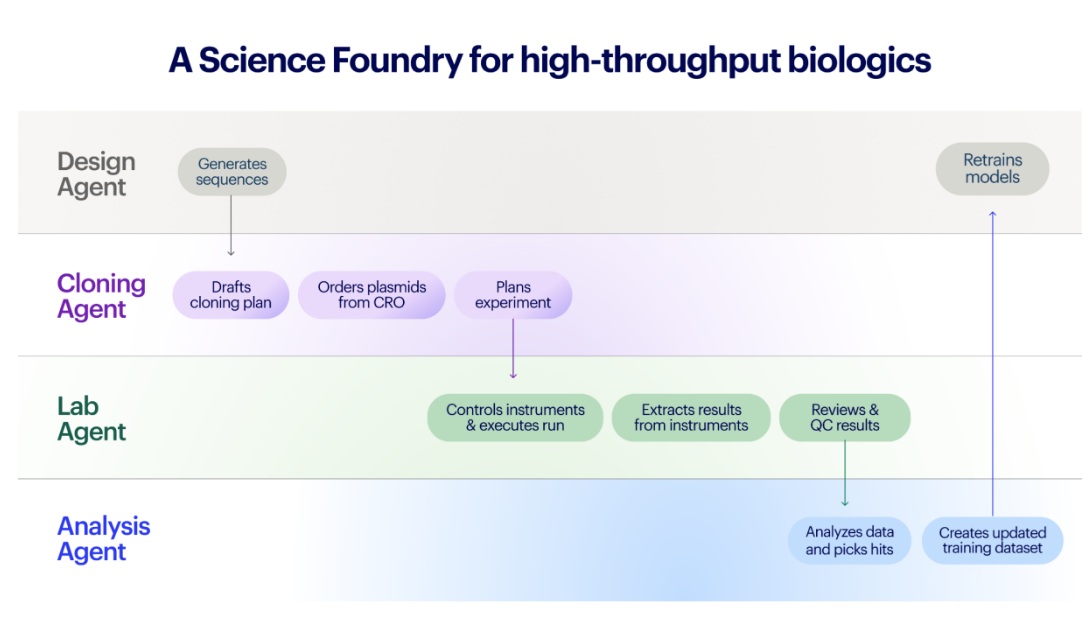
The flagship example comes from a pharma team designing, producing and testing antibodies at high throughput. That team already had design models, CROs to synthesize constructs and lab automation for production and assays. The problem was connecting them: scientists were moving data by hand from one step to the next. Its Foundry now splits the work across four agents:
- A design agent generates and evaluates sequences with scientific models.
- A cloning agent drafts the assembly strategy and places orders with a CRO.
- A lab agent sends instructions to workcells, captures the data and runs QC.
- An analysis agent interprets results and updates the training datasets.
Benchling emphasizes two benefits. The first is speed between steps: an assay that finishes at 11pm is analyzed by the time the scientist arrives. The second is the ability to run more experiments. Agents can run several design strategies against the same goal in parallel, where a team used to test one at a time.
"Running them in parallel toward one scientific goal is a new kind of challenge," said Ashu Singhal, Benchling's co-founder and President, referring to lab automation, CROs and generative models.
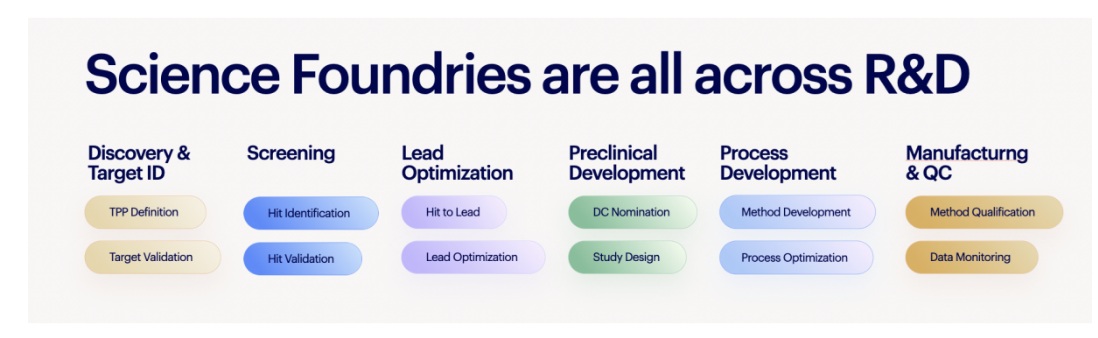
Benchling customers can set up Science Foundries starting today. Each engagement begins with one process that matters to the organization, such as protein production, screening, assay development, method development or in vivo work. Benchling AI then builds the first Foundry. The company is also developing Foundries for therapeutic area, preclinical and process development teams. The announcement does not mention pricing.
Six months, one direction
Read on its own, Science Foundries sounds like one more agent launch in a crowded year for AI in R&D. Set against Benchling's last six months, it looks more like the next step in a plan. Benchling describes the common thread as bringing the wet lab and the dry lab closer together, and its spring and summer launches did that one piece at a time.
The first pieces dealt with physical work. In early May, Benchling added direct ordering, letting scientists send designs to Twist Bioscience and Adaptyv without leaving the notebook, with Ginkgo Bioworks to follow later in the year. Results come back as structured data linked to the original designs. Three weeks later, on May 28, Benchling Automation brought the same idea inside the lab. This hardware-agnostic layer sends runs to workcells and instruments, reads data from more than 200 of them, and returns analyzed results to the notebook. It launched with HighRes, Automata, Ginkgo, Celltrio, Opentrons and Hamilton. Between them, these two launches cover much of what today's cloning and lab agents do: placing orders with CROs, dispatching work to workcells and capturing the data.
In between came a reminder of why the data matters. On May 10, Benchling published a customer story with Prime Medicine, which is taking PM359, a prime-edited stem cell therapy for chronic granulomatous disease, toward a BLA. To get there, Prime must validate 35 product-specific assays. For the potency assay, Benchling's AI Scientist mined more than 50 past experiments, mapped each data point to ICH Q2(R2) requirements, designed follow-up studies and drafted the validation report. Benchling says months of work shrank to days. That was only possible because Prime had recorded every experiment in Benchling since 2022.
The summer turned to models and reuse. On July 30, Benchling opened Benchling.ai to anyone, customer or not. Researchers can run the latest structure prediction models in under a minute, with up to $1,000 of free use a year and no sales call, while customers can run models inside Benchling through Model Hub. Models like these are what a design agent relies on, and the free service doubles as an introduction to Benchling for researchers who don't use it yet. Then, on August 10, came vibe coding. Scientists prompt for dashboards and trackers built on their own data and save them as "Skills" that agents can reuse. For Foundries, Skills could offer a way to repeat agent work rather than rebuild it each time.
Seen this way, much of the groundwork for Foundries was already in place by the end of the summer. What launched today is the layer that connects those pieces into whole workflows.
A reality check from Benchling itself
Benchling's own research offers a useful counterweight to today's launch. In August, it published BenchBench-Protocol, a benchmark built from thousands of real experiments. It tests whether models can troubleshoot and optimize wet-lab protocols the way experienced scientists do. The top model, Opus 5, scored 59.2%, ahead of GPT 5.6 at 47.1% and the open-source Kimi K3 at 45.7%.
The models' mistakes were practical ones. Their answers sounded right on paper but skipped calibration, treated visibly impure samples as pure, or missed small changes in technique that can ruin a run. As Singhal wrote, knowing biology and doing biology are different things.
That gap helps explain why Foundries keeps scientists at the approval gates, and why the Prime story stresses AI supporting the team's judgment rather than replacing it. It also cuts both ways. Benchling is well placed to know where agents fail, but as the company selling the system, it won't be the only source customers want to hear from before trusting agents with consequential decisions.
What it all means
From system of record to system of action. For most of its history, Benchling was where science got written down: the notebook, the registry, the LIMS. With Science Foundries, Benchling wants to manage the experiments themselves, not just record them. That expands both its role in R&D and its potential revenue. Instead of competing mainly on how well it manages experimental data, Benchling can now compete on how efficiently its customers run experiments.
The moat is the data, not the agents. Agents are getting cheaper and more interchangeable by the month. What can't be copied quickly is years of structured experimental history, like the four years of Prime records that made its validation work possible. Benchling is betting that access to relevant experimental context will determine how useful agents become. It already holds that context for more than 1,300 companies.
Switchboard, not a walled garden. Almost every piece of the stack belongs to someone else: models from open consortia, synthesis from Twist and Adaptyv, robots from HighRes and Hamilton, cloud labs from Ginkgo. Benchling positions itself as the software layer connecting these systems and keeping track of the resulting data. That approach makes sense for a software company operating in a field that relies heavily on specialized hardware. But some of its partners may eventually try to provide the same integration layer.
Two funnels, one strategy. Benchling.ai gives models away to anyone, customer or not. Foundries give existing customers more reasons to use Benchling throughout their R&D processes, rather than only for data management. The free models can attract new users, while Foundries could make existing customers more dependent on the platform.
Benchling envisions labs where scientists oversee multiple AI agents working with models, robots and external service providers. Instead of manually coordinating each step, scientists would review results and decide which experiments to pursue next. Whether this works in practice will depend on model reliability, integration with lab systems and access to experimental history. Benchling already has an advantage in the last of these, thanks to the data its customers have accumulated on the platform.
Topic: AI in Bio