The Infrastructure Layer: 30 Platforms Powering Human-Relevant Drug Development
Infrastructure for large-scale biomedical data — from multi-omics to EHRs — is converging with a growing policy and business case for data-native drug development.
In this article: Clinical Data & Real-World Evidence Platforms — Biobank & Biological Data Platforms — Electronic Health Record Data Enrichment & Integration — Genomic & Multi-Omics Big Data Companies — Clinical Trial Data & Decentralized Trial Platforms — AI-Driven Drug Discovery Platforms — Wearable & Patient-Generated Health Data Platforms
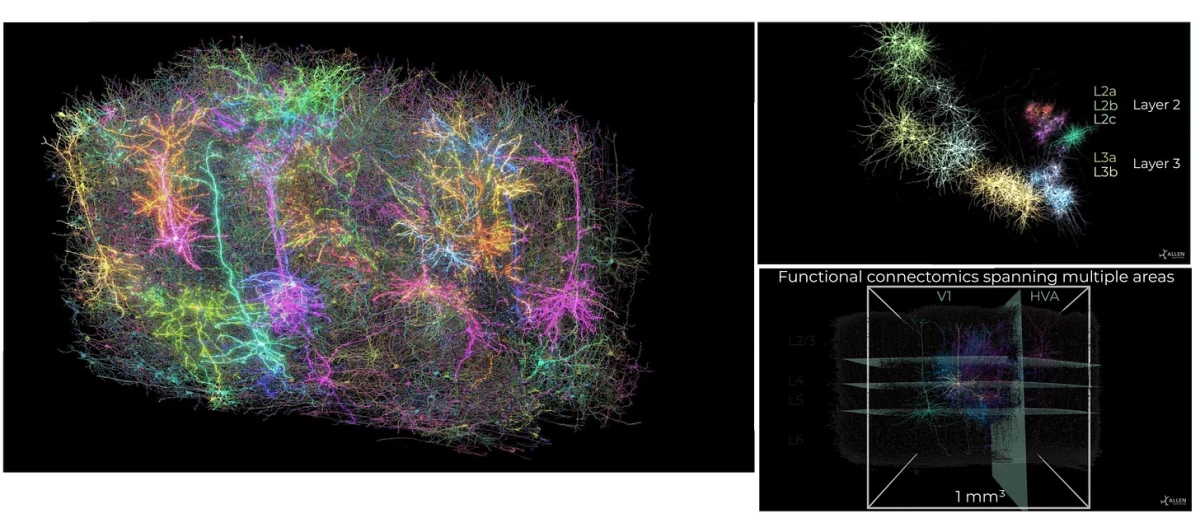
In parallel, over 100 researchers working under the MICrONS program released a map of one cubic millimeter of mouse brain tissue. The team, led by the Allen Institute, Princeton, and Baylor College of Medicine, reconstructed 200,000 cells and 523 million synapses using 28,000 brain slices. The resulting dataset is 1.6 petabytes of high-resolution imaging paired with in vivo activity recordings.

Built through 20 years of effort, the MICrONS Project reveals the most detailed 3D map of a mouse brain region to date, combining real-time neural activity with synapse-level structural detail. Image: Allen Institute, Tyler Sloan in Nature
It’s less than 1% of a mouse brain. But it already revealed new circuit motifs involving inhibitory neuron types like chandelier and Martinotti cells. The dataset is open access and intended as a scaffold for future precision neurotherapeutics.
Looking back to 1965, Margaret Dayhoff compiled just 65 protein sequences in her Atlas of Protein Sequence and Structure. The entire dataset fits into a few kilobytes—small enough to store on a floppy disk or email as a modern PDF. Today, a single biomedical project can generate petabytes. That’s a billion-fold increase in volume.
This kind of output, unthinkable two decades ago, is now routine in many areas of biomedicine. GenBank stores over 250 billion nucleotide bases. UK Biobank holds more than 30 petabytes across genomic, imaging, and health data. Tempus AI processes 300 petabytes across multimodal clinical and molecular datasets. AlphaFold’s 200 million protein predictions add another 23 terabytes of modeled biology.
What made this scale-up possible? Faster compute, cheaper storage and better compression. And a growing ecosystem of tools to ingest, clean, and analyze multi-source biomedical data in real time.
In a major policy shift, the FDA had just expanded the use of New Approach Methodologies (NAMs) in Investigational New Drug (IND) submissions, starting with monoclonal antibodies and other therapeutics. The update allows developers to replace certain animal studies with validated alternatives, including in silico models, human cell assays, and organoid systems. This move builds on the FDA Modernization Act 2.0, which in 2022 removed the federal requirement for animal testing in some cases. The regulatory framework is now shifting toward more modern, mechanistic, and human-relevant tools in early-stage drug development.
According to Enke Bashllari, founder and managing director at Arkitekt Ventures, these shifts open up significant opportunities for startups focused on AI-driven prediction, modeling, and simulation in drug development.
These include PBPK/PD digital twins that simulate drug absorption, distribution, metabolism, and excretion to identify risks before human trials. AI toxicology, which applies deep learning to chemical structures and historical toxicology data, could be used to predict organ-specific safety concerns earlier in the pipeline. Virtual trial digital twins offer the potential to model synthetic patient populations using real-world data, genomics, and physiological parameters to improve trial design.
Other areas of opportunity include proteome profiling, where AI can map on- and off-target protein interactions across thousands of proteins to help prioritize compounds before wet-lab testing, and pharmacogenomics engines that integrate genomic, transcriptomic, and exposomic data to model response variability and support precision dosing. End-to-end predictive models that combine imaging, multi-omics, and clinical outcome data could also play a role in evaluating both safety and efficacy across the development pipeline.
Who is building, scaling, and using the infrastructure that could make this possible?
Let’s have a look at a crop of newer companies either generating massive biological datasets or building the tools to make sense of them. Think real-world evidence engines, privacy-first data exchanges, genomic stacks, AI discovery engines, and infrastructure for decentralized clinical trials.
Clinical Data & Real-World Evidence Platforms
Aetion
Founded: 2012 — New York, NY, USA
Aetion develops software for analyzing real-world data to support decision-making in drug development, regulatory submissions, and health policy. Its main product, the Aetion Evidence Platform (AEP), is used to conduct regulatory-grade analyses of healthcare data, including claims, electronic health records, and registries. AEP is applied in areas such as comparative effectiveness research, safety studies, and market access evaluations.
The platform is used by regulatory agencies including the U.S. FDA and EMA. Aetion has also partnered with NEC to support studies using Japanese health records. The company has raised $212M to date, including a $110M Series C round in May 2021 backed by Warburg Pincus, B Capital, and NEA.
HealthVerity
Founded: 2014 — Philadelphia, PA, USA
HealthVerity builds data infrastructure for real-world evidence generation, with a focus on identity resolution, privacy compliance, data governance, and exchange. Its IPGE platform links de-identified patient data across disparate sources, including claims, lab data, and electronic health records, while adhering to privacy regulations. Over 250 organizations use the platform, including more than 80% of the top U.S. pharmaceutical and biotech companies.
The company also operates the HealthVerity Marketplace, which aggregates real-world and consumer data assets, and provides infrastructure for managing consent and data access. Its technology has been used in research and analytics initiatives by the U.S. Department of Health and Human Services, FDA, and NIH, particularly during the COVID-19 pandemic (source).
HealthVerity has raised approximately $142M in venture capital. Its most recent round was a $100M Series D in June 2021, led by Durable Capital Partners, with participation from Flare Capital Partners, Foresite Capital, and Greycroft.
OM1
Founded: 2015 — Boston, MA, USA
OM1 provides real-world data and AI-based analytics for understanding and tracking chronic and specialty diseases. Its dataset covers over 300 million patient records sourced from electronic medical records, claims, and clinical documentation. Therapeutic areas include rheumatology, cardiometabolic disorders, mental health, dermatology, and immunology.
The company's PhenOM platform applies AI to extract and standardize information from unstructured clinical data, improving disease classification and patient segmentation. OM1 also offers Aspen, a platform for developing registries and conducting longitudinal studies across healthcare networks and industry partners.
OM1 has raised ~$171M in funding. Its most recent round, an $85M Series C in 2021, included investors such as Kaiser Permanente, Breyer Capital, General Catalyst, and Scale Venture Partners. In 2023, OM1 expanded into Europe to meet growing demand for real-world evidence capabilities in global life sciences markets.
Tempus AI
Founded: 2015 — Chicago, IL, USA
Tempus AI offers a precision medicine platform that integrates AI with multimodal clinical and molecular data to support personalized healthcare. Its solutions include Tempus One, an AI assistant for physicians, and Loop, a discovery engine that combines real-world evidence with CRISPR screens to identify and validate novel drug targets. The company supports over 50% of U.S. oncologists through sequencing, clinical trial matching, and research-enabled partnerships.
Tempus processes more than 300 petabytes of clinical and molecular data, with over 8 million de-identified research records in its library.
The company raised over $1.3B in private funding from investors including Google, Baillie Gifford, and Franklin Templeton. In June 2024, Tempus went public (NASDAQ: TEM), raising $410M at a $6.1B valuation.
Biobank & Biological Data Platforms
GeneDx
Founded: 2000 — Gaithersburg, MD, USA
GeneDx specializes in genomic testing, focusing on rare and pediatric diseases through whole exome and genome sequencing. The company offers diagnostic services for conditions including hereditary cancers, cardiomyopathies, mitochondrial disorders, and neurological diseases. Its platforms, such as ultraRapid Genome sequencing, aim to provide timely diagnosis, particularly for critically ill infants in neonatal intensive care units.
In 2024, the company achieved an and conducted , marking a 51% year-over-year growth.
To read the rest of this article, upgrade to a BiopharmaTrend Pro subscription.
Gain full access to all of our deep dives and content archives.