Next Generation Sequencing: New Tech and Companies to Watch
From the discovery of the double helix to the latest AI-driven innovations.
In this article: Roche’s NGS Trajectory — Sequencing History — NGS in Healthcare — Notable Recent NGS Events — Established Market Players & Strategic Acquisitions — Startups to Watch — Future Outlook
Roche's latest development, Sequencing by Expansion (SBX), marks a promising shift in NGS technology. SBX departs from conventional PCR-based amplification by using an enzymatic method that expands individual DNA molecules, creating larger, more easily detectable signals. The key to this improvement in signal resolution is the so-called "Xpandomer", an expanded DNA surrogate 50 times longer than conventional DNA strands. This process uses expandable nucleotide triphosphates (X-NTPs) to encode highly distinguishable reporter signals, enabling precise sequencing. By transforming DNA into these elongated Xpandomers, SBX overcomes the spatial resolution and signal-to-noise challenges inherent in conventional sequencing methods.
According to the claims in the publicly available sources, SBX is capable of sequencing seven human genomes at 30X coverage per hour with accuracy exceeding 99.8%. Roche has begun deploying SBX instruments to early access sites such as the Hartwig Medical Foundation in the Netherlands and the Broad Institute. SBX will initially be available for research use, with early access already underway and a full commercial release expected in 2026. Pricing and sample preparation details remain undisclosed, but Roche communicated its plans to expand SBX into clinical applications over time.
While the news is dominated by Roche’s development, the NGS field is a rapidly evolving space with lots of players and technological advances.
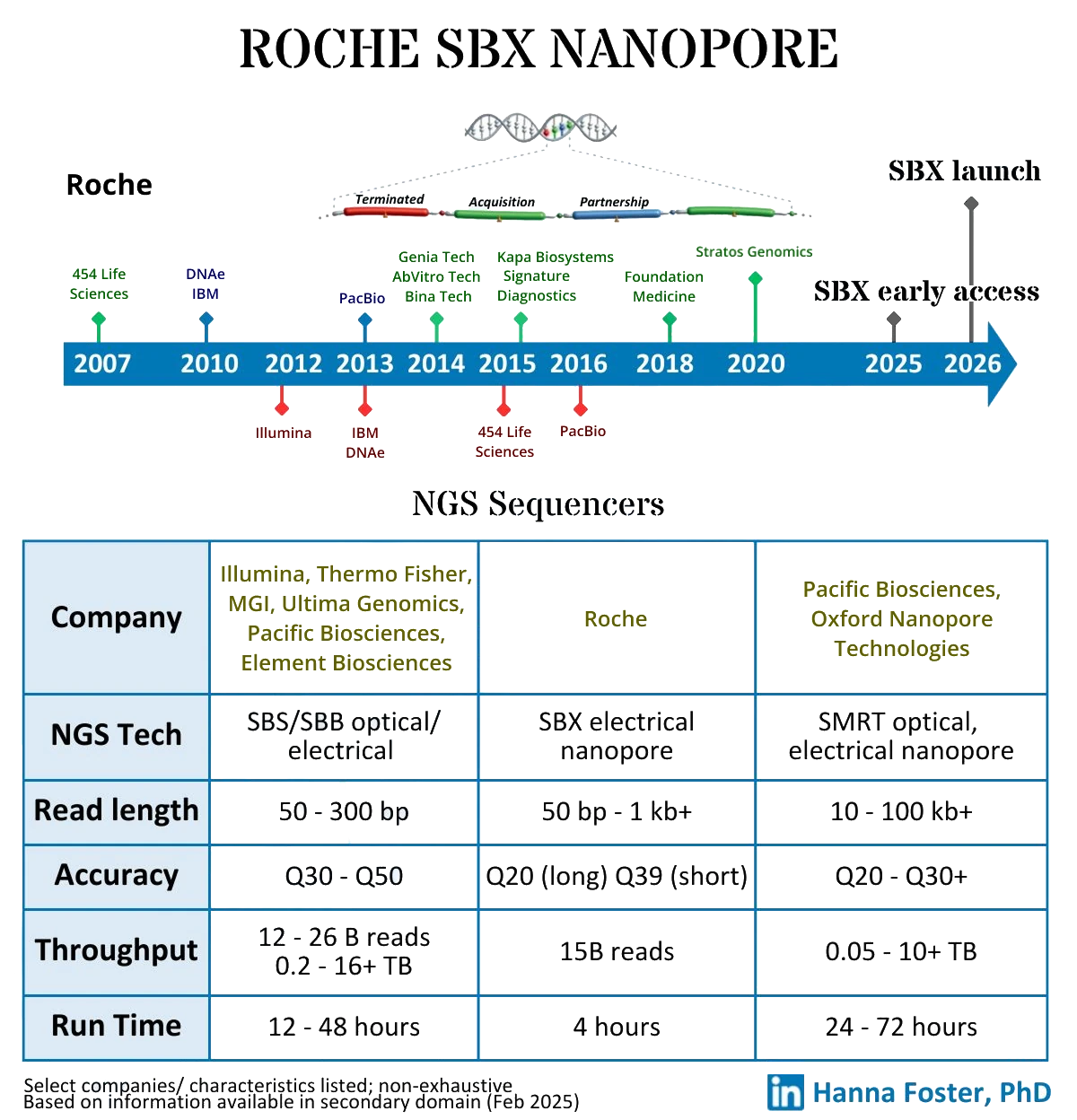
Roche SBX Nanopore timeline and performance comparison (courtesy of Hanna Foster, PhD)
Journey Through the Sequencing History
Today, the global NGS market is projected to surpass $22 billion by 2029, fueled by advancements in AI-driven analysis, multi-omics integration, and spatial biology. The increased demand for sequencing is also bolstering adjacent sectors, with the sequencing reagents market expected to reach $21.91 billion by 2030.
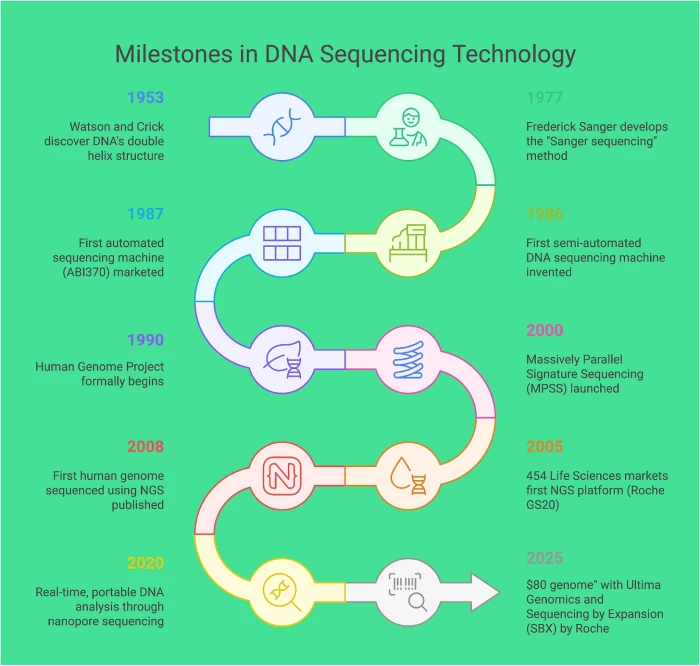
The history of DNA sequencing might read like an eventful novel, with each breakthrough opening up new chapters and possibilities:
-
Back in 1953, Nobel-prize Watson and Crick's discovery of DNA's double helix structure gave us the understanding of genetic information storage.
-
Little over 20 years later, in 1977, Frederick Sanger developed his revolutionary sequencing method, which laid the fundament for the DNA sequencing space.
-
In 2000, the advent of Massively Parallel Signature Sequencing (MPSS) enabled the simultaneous sequencing of millions of DNA fragments, significantly increasing throughput and reducing costs.
-
The commercial introduction of pyrosequencing by 454/Roche in 2005 further shortened the time required to sequence entire genomes from years to days. The early 2010s saw the emergence of third-generation technologies—such as PacBio’s SMRT and Oxford Nanopore’s platforms—that extended read lengths and improved portability.
-
By 2020, nanopore sequencing has enabled real-time, portable DNA analysis, and by 2025, developments like Ultima Genomics’ “$80 genome” and Roche’s SBX promise to advance genomic accessibility and speed even further.
NGS in Healthcare
Next-Generation Sequencing has changed many aspects of healthcare. In cancer, it uncovered novel mutations, leading to targeted therapies like PARP inhibitors for BRCA1/2 mutations, offering hope in treating ovarian, pancreatic, breast, and prostate cancer. For rare diseases, whole-genome and whole-exome sequencing have dramatically improved diagnosis rates, sometimes from 10% to over 50%, enabling earlier interventions.
In drug discovery NGS is used for enabling identification of novel drug targets through comprehensive genomic analysis. Pharmacogenomics has enabled personalized medicine approaches by identifying genetic variants influencing drug response. NGS is also believed to have played a role in addressing antimicrobial resistance by enabling rapid analysis of pathogen genomes, informing new strategies for treatment. 2025 seems to be shaping as an exciting year for NGS progress.
Bringing together multi-omics approaches is starting to uncover how genetic, epigenetic, transcriptomic, proteomic, and metabolomic factors come together to shape health and disease. According to Rami Mehio from Illumina, leveraging multi-omics data efficiently will require intensification of informatics in the form of better organization, storage, and analysis of large amounts of information. Industry representatives like Gordon Sanghera from Oxford Nanopore and Molly He from Element Biosciences expect to see direct analysis of DNA, RNA, and epigenomes on large-scale populations, as well as the utilization of multi-omics in AI-assisted drug discovery.
More about the upcoming year’s predictions from six NGS leaders in this article on GEN.
Several companies are integrating multi-omics and NGS methods to enhance clinical diagnostics and support drug discovery:
To read the rest of this article, upgrade to a BiopharmaTrend Pro subscription.
Gain full access to all of our deep dives and content archives.