How AI Powers Synthetic Biology
Let's face it, we are living in a "century of biology" and artificial intelligence is a growing enabler of what comes next.
For billions of years, evolution was the only author of the genetic code. Modern synthetic biology opens doors for us to become active co-writers.
This May, researchers from the Centre for Genomic Regulation (CRG) reported the first use of generative AI to design DNA sequences that regulate gene expression within living mammalian cells. The team focused on synthetic enhancers—short DNA “switches” that control when and where genes are activated. In their proof-of-concept, they tasked the AI with generating enhancer sequences able to switch on a fluorescent reporter gene in specific mouse blood cells, while remaining silent elsewhere. The ~250-base-pair sequences were synthesized, delivered into cells by a virus (notably, they were integrated at random locations), and performed as intended in healthy mouse blood cells.
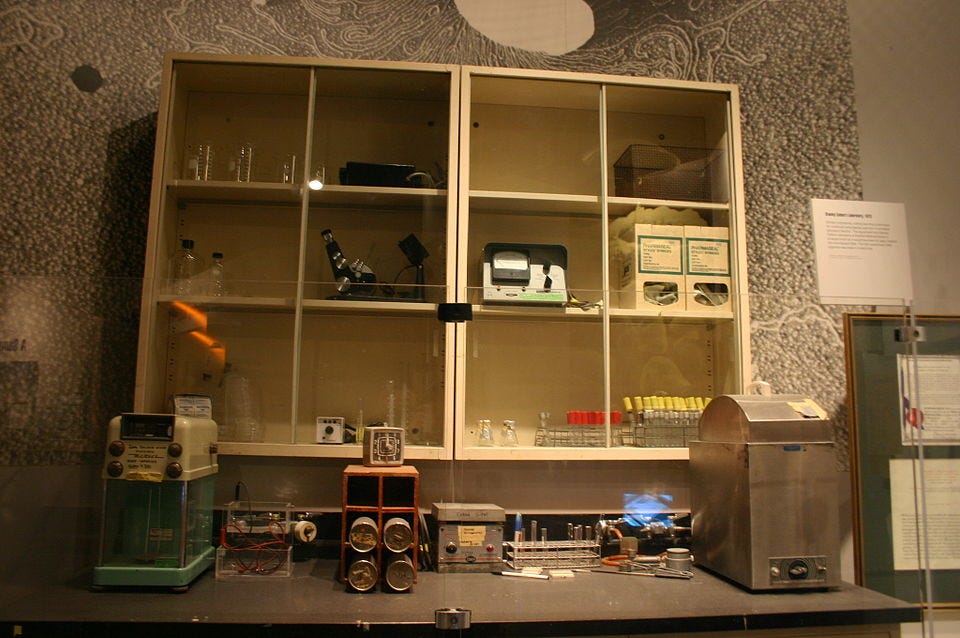
Stanley Norman Cohen‘s Genetic Engineering Laboratory, 1973 - National American History Museum’s Science in American Life exhibit. Courtesy of Ryan Somma. License: CC BY-SA 2.0
What CRG demonstrated fits into the typical synthetic biology workflow—where we define a functional specification, generate design candidates, synthesize them, and test them in cells. DNA elements are treated as modular parts composed into higher-order circuits and systems. Borrowing principles from classical engineering like standardization, abstraction, iteration, synthetic biology turns cellular programs into designable constructs.
These days, AI and machine learning are being applied all over the life sciences, and we’ve been tracking this closely across recent updates. Before diving into what’s happening in AI-SynBio today, let’s zoom out and see how the field emerged.
In this article: Historical Throughline — Where Do AI and Synbio Converge? — Sequence Acquisition and Analysis — Modelling Sequences and Predicting Functionality — Accelerating Therapeutics Design and Automating DBTL — Enabling Novel Biosystems — Increasing Access — Synthetic Biology, Natural Danger
To read the rest of this article, upgrade to a BiopharmaTrend Pro subscription.
Gain full access to all of our deep dives and content archives.