From Biohacking to Healthcare: The Growing Pains of the Longevity Industry
Part I: A tour of the therapeutic strategies targeting the hallmarks of aging—from cellular reprogramming to senolytics, mTOR inhibitors, and immune rejuvenation.
Part I: Therapeutic strategies that target the hallmarks of aging
Recent developments suggest that the longevity industry is beginning to outgrow its infancy and move into a more mature formative stage. What started with academic aging research, biohacking, mouse studies, and occasional n=1 self-experiments is increasingly evolving into a well-funded biotech ecosystem focused on translating aging-related mechanisms into clinical development. A prominent example is Life BioSciences, the cell-rejuvenation company co-founded by aging researcher David Sinclair, which recently raised an $80 million Series D round to advance its first-in-human clinical program in optic neuropathies. Beyond cellular rejuvenation, a growing number of biotechs are developing therapies aimed at other hallmarks of aging, from senescence to metabolic dysregulation.
At the same time, despite these encouraging signs of momentum, the longevity industry still faces fundamental challenges, including the absence of a unified hypothesis of aging and the lack of robust proxy markers that can reliably measure biological aging and therapeutic impact.
The promise and challenges of the budding longevity industry
For most of human history, living longer mainly meant not dying early. Over the past two centuries, particularly in the 20th century, clean water and sanitation, improved nutrition, vaccines and antibiotics, and safer maternal, neonatal, and emergency care helped push average life expectancy up by decades.
In many high-income settings, however, the pace of improvement has slowed since the 1990s, while at the same time the burden of chronic disease has increased significantly. This raises a new question: how can we live longer, individually and as a society, without simply shifting the burden into more years lived with chronic disease?
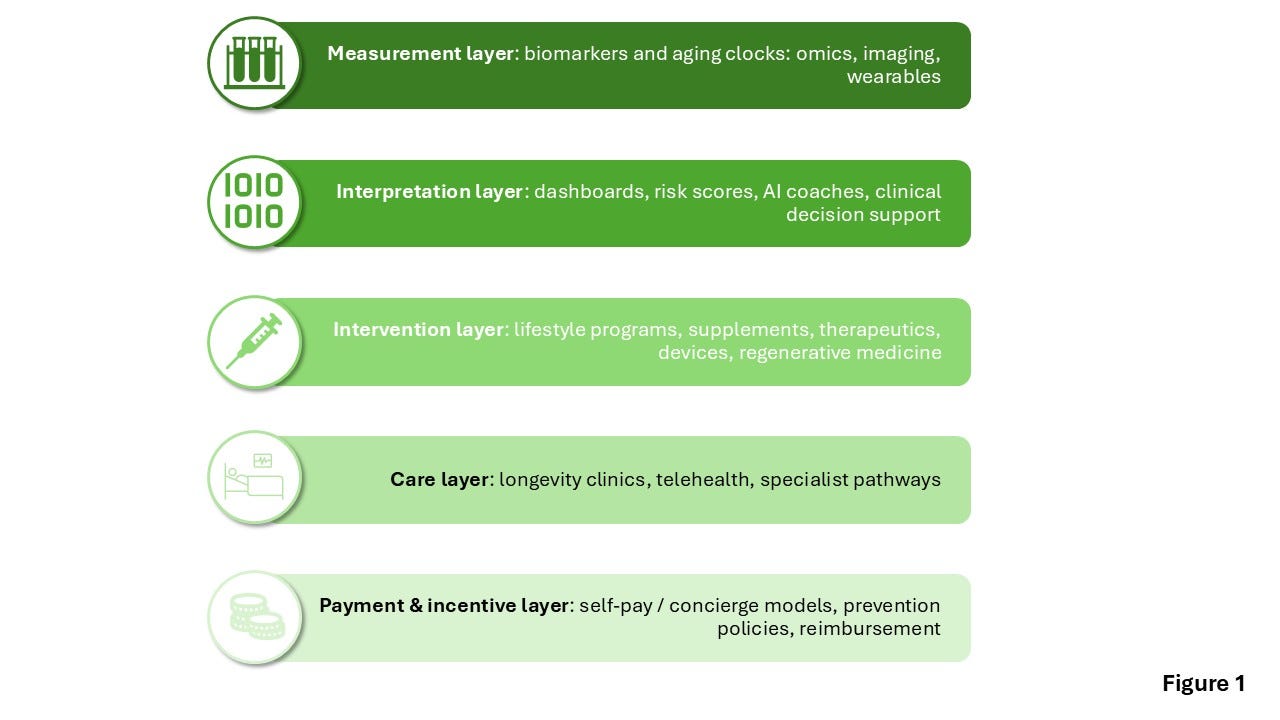
Researchers are increasingly reframing the problem away from purely disease-by-disease fixes and toward the underlying biology of aging that contributes to multiple conditions, such as cancer, cardiovascular, neurodegenerative, and metabolic disease. While the field is only beginning to untangle the complex, and likely multifactorial process of aging, a fledgling longevity industry has emerged around various hypotheses of aging mechanisms. This longevity stack spans different layers from biomarkers and aging clocks that aim to measure biological aging, to therapeutics that target aging-linked mechanisms, as well as care and delivery models (clinics, digital platforms, consulting) that package measurement and interventions into services (Figure 1).

The industry is supported by a growing ecosystem of specialized longevity capital firms, which emerged around the idea of aging biology as an investment opportunity. Alongside Sergey Young’s Longevity Vision Fund, firms like, Apollo Health Ventures and Healthspan Capital and others are building portfolios of companies that aim to tackle the root causes and accompanying symptoms of aging. At the same time, non-profit organizations, such as Hevolution, Lifespan Research Institute and the Methuselah Foundation are offering grants and partnerships to foster breakthroughs in the longevity field, while the XPRIZE competition offers $ 101 M over 7 years for teams that develop longevity therapeutics.
However, biotechs in the longevity space face major scientific and regulatory hurdles. On the one hand, incomplete understanding of which mechanisms are causal drivers versus downstream effects of aging challenges hypothesis selection for new treatments and aging markers. On the other hand, the lack of standardized, validated biomarkers and endpoints make it hard to select the right proxies for early readouts of aging. Notably, aging itself is currently not classified as a disease indication within a regulatory approval pathway.
In part 1 of this three-article series, we explore therapeutic strategies that tackle the hallmarks of aging. In part 2, we’ll dive into aging biomarkers and biological clocks, and in part 3, we’ll analyze consumer-facing longevity companies and longevity clinics.
Therapeutic strategies for combatting aging
To read the rest of this article, upgrade to a BiopharmaTrend Pro subscription.
Gain full access to all of our deep dives and content archives.