BioPharmaTrend
Latest Insights
Companies
  • Companies Directory
  • Case Studies
Newsletter
About
  • At a Glance
  • Our Team
  • Advisory Board
  • Citations and Press Coverage
  • Partner Events Calendar
  • Advertise with Us
 
 Subscribe 
Sign in
  • AI in Bio
  • Tech Giants
  • Next-Gen Tools
  • Business Intelligence

  Business Intellilgence

Five Genomics Watchpoints for 2026

by BiopharmaTrend   •   Feb. 20, 2026

Disclaimer: All opinions expressed by Contributors are their own and do not represent those of their employers, or BiopharmaTrend.com.
Contributors are fully responsible for assuring they own any required copyright for any content they submit to BiopharmaTrend.com. This website and its owners shall not be liable for neither information and content submitted for publication by Contributors, nor its accuracy.

Share:   Share in LinkedIn  Share in Bluesky  Share in Reddit  Share in Hacker News  Share in X  Share in Facebook

Industrial functional genomics, modular gene editing, embryo ranking, falling sequencing costs, and scaled DNA synthesis start to connect into one end-to-end pipeline.

The beginning of this year is already offering a couple of data points that pick up last year’s momentum and hint at where genomics might be moving next. On January 13, during JPM week, Illumina announced the Billion Cell Atlas — a genome-wide perturbation dataset built from 1B cells meant as the foundation for large-scale target validation and AI model training. With AstraZeneca, Eli Lilly, and MSD involved, the initiative was framed as an attempt to create a standardized map of gene function that could be reused across different drug discovery programs.
Just a day earlier, MIT Technology Review published its annual 10 Breakthrough Technologies list. This year, three of the highlighted technologies were in genomics: personalized gene editing, embryo scoring, and gene resurrection. From there, it seems like genomic applications are moving more into the mainstream technology discourse.

Another just-in data point from a few days ago is a report out of San Diego, where Element Biosciences says its newly announced VITARI benchtop sequencer can deliver a whole genome for $100, positioning it as a lower-cost alternative to Illumina’s high-throughput systems.


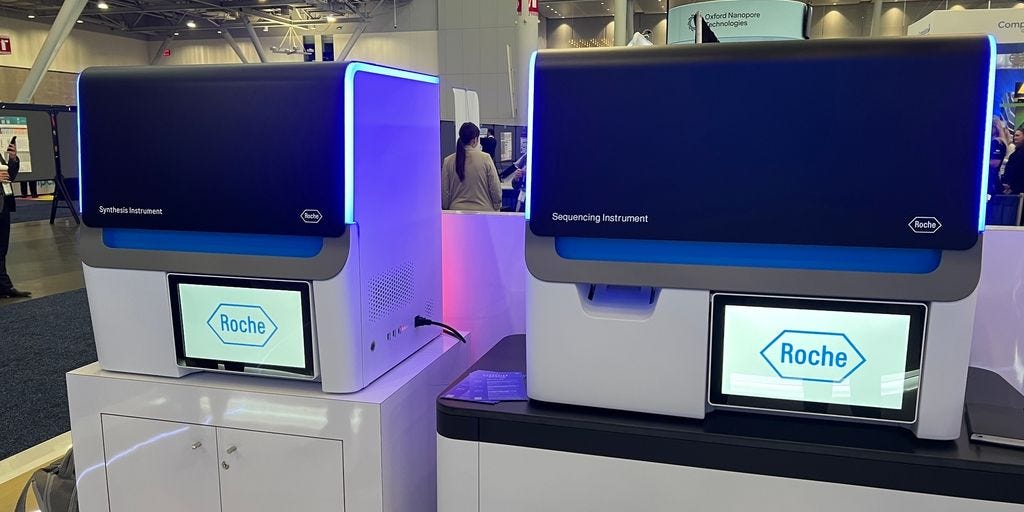
Photo: Roche’s SBX setup

Looking at these and many of last year’s developments, genomics come into view as an integrated technology wave that extends from data generation to interpretation, intervention, and biological reconstruction.

With those early-2026 pings as a starting point, let’s do a selective pass through a few genomics patterns that seem to be carrying momentum into 2026.


1️⃣ Perturb-Seq Data Cornerstone

The first recent trend in genomics worth mentioning is the industrialization of functional genomics data. The industry does not strive for simply “more single-cell sequencing” but rather for standardized, genome-wide perturbation datasets built for reuse across pharma and AI systems, like in Illumina’s case above.

Single-cell perturbation sequencing (Perturb-seq) captures how individual cells respond to targeted genetic interventions. Each cell carries a defined guide RNA that is read out alongside its transcriptomic state, linking a specific perturbation to a high-dimensional molecular response. Unlike observational atlases (Human Cell Atlas, CZI Biohub’s Tabula Muris/Sapiens, Allen Institute’s Cell Types resources/Allen Brain Cell Atlas etc.), these datasets are interventional in that they enable causal mapping of regulatory networks rather than correlation alone.

In this causal nature lies the strategic value of perturbation data: changes in gene expression signatures can support target validation, mechanism-of-action studies, drug repurposing, and in silico modeling. As a result, larger, well-annotated perturbation signature collections may improve drug-discovery potential, depending on data quality and coverage.

Early Perturb-seq datasets demonstrated feasibility but were too small to enable predictive systems at scale. The first dataset released by the technology developers in 2016 comprised roughly 200,000 cells. Subsequent efforts expanded with genome-wide Perturb-seq by Replogle et al. reaching ~2.5M cells (2022), while the PerturBase aggregates ~5M cells (2024-2025). This still reflects the upper bound of most public perturbation datasets. By contrast, private efforts are already pushing well beyond that range:

  • Xaira Therapeutics’ 2025 X-Atlas/Orion dataset marked a previous record with roughly 8M single cells which targeted all human protein-coding genes, and featured deep sequencing coverage of over 16,000 unique molecular identifiers (UMIs) per cell. To foster collaboration within the virtual cell community, the dataset was made publicly available under a non-commercial license.
  • Illumina’s Billion Cell Atlas set a new benchmark, comprising 1B cells across 200 disease-relevant cell lines with the planned expansion to 5B cells.


To read the rest of this article, upgrade to a BiopharmaTrend Pro subscription.

Gain full access to all of our deep dives and content archives.

 Upgrade to Pro 

Already a member? Sign in here.
Share:   Share in LinkedIn  Share in Bluesky  Share in Reddit  Share in Hacker News  Share in X  Share in Facebook

BiopharmaTrend.com

Where Tech Meets Bio
mail  Newsletter
in  LinkedIn
x  X
rss  RSS Feed

About


  • What we do
  • Press & Citations
  • Terms of Use
  • Privacy Policy
  • Cookies Policy
  • Disclaimer

Topics


  • News
  • AI in Bio
  • Tech Giants
  • Next-Gen Tools

Explore


  • Premium Insights
  • Business Intelligence
  • Companies
  • Events
  • Authors

Partner


  • Sponsorship
  • Editorial Calendar

© WTMB Research & Media, S.L. (WTMB Group)   2026
We use cookies to personalise content and to analyse our traffic. You consent to our cookies if you continue to use our website. Read more details in our cookies policy.