Everyone is Launching AI Agents. What's Being Deployed?
A deep dive on the next cycle of biopharma's AI buildout
Last year's "growing buzz around AI agents" that we surveyed has since grown into a full avalanche of infrastructure commitments, partnerships, and agent launches across nearly every corner of biopharma. Let's take a fresh look.
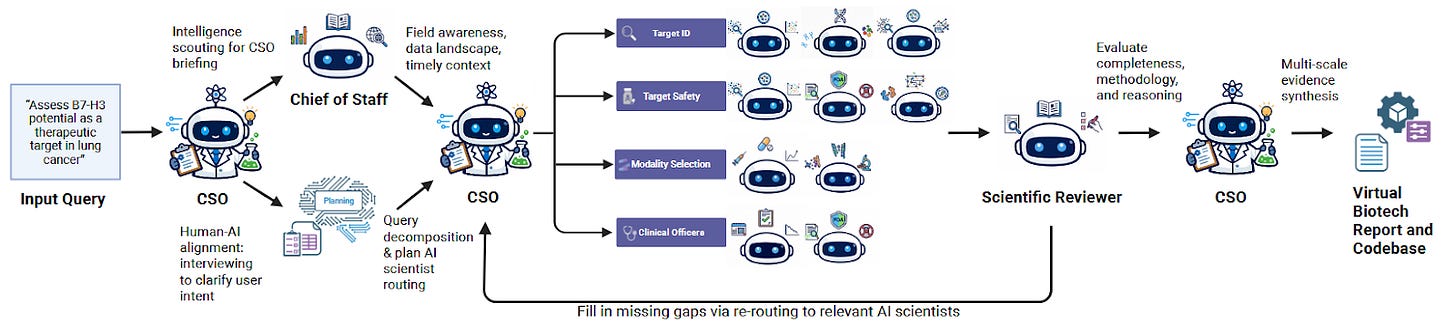
A team at Stanford recently posted a preprint describing a system they called “Virtual Biotech”: a coordinated squad of AI agents organized to mirror a real drug discovery company, complete with a virtual Chief Scientific Officer, specialized scientist agents, and over 100 tools for querying biomedical databases.
For their headline demonstration, they deployed over 37,000 agents in parallel, each one tasked with annotating a single clinical trial, linking therapeutic targets to genomic and single-cell transcriptomic features. The resulting dataset spans 55,984 trials. The analysis turned up what the authors call previously unreported associations: drugs targeting cell-type-specific genes were 40% more likely to advance from Phase I to Phase II, 48% more likely to reach market, and showed 32% lower adverse event rates.

Virtual Biotech workflow. User query > CSO clarification and briefing preparation > specialized scientist agents > scientific reviewer > synthesis or revision. Source: Zhang et al., bioRxiv, Feb. 23, 2026.
In another case study, the system pulled together genetics, transcriptomics, and clinical data on B7-H3 in lung cancer and landed on an antibody-drug conjugate strategy, the same bet several pharma companies are already running in the clinic. It also flagged liabilities and differentiation angles. The whole thing reportedly cost $46 in API credits and took less than a day.
The Virtual Biotech is one lab’s preprint, but it lands in what we recently likened to a “gold rush”—agents are being deployed across clinical operations, translational biology, antibody design, and regulatory workflows. Major pharma companies are in an apparent compute arms race, stacking GPU clusters and billion-dollar AI partnerships within months of each other. Startups backed by hundreds of millions are launching agent-focused platforms. NVIDIA’s Jensen Huang even went so far as to declare agentic AI “the new computer” at this year’s GTC.
Whether the implementations match is another question. In a recent experiment, researcher Liang Chang asked — ”Can AI make better decisions than pharma executives?” and sent AI agent teams back to a pivotal 2012 decision in oncology, the BMS vs. Merck biomarker strategy that ultimately decided the Keytruda-Opdivo war, and found that both Claude and GPT independently recommended the same path BMS took. The path that lost.
The agents produced rigorous analysis, identified the exact competitive threat, and still followed the consensus. As Chang put it: “AI can give you the best possible analysis. It can’t give you the courage to go against it.”
What can AI agents do today, where are they falling short, and why is everyone building them?
🤖 Why agents, and why now?
A historical detour. The term “agent” gets used loosely enough in AI marketing that it might be worth tracing from its original meaning. The ideas behind it were actually tested long before today’s language model AI existed. The fundamental idea behind an agent is a feedback loop where a system perceives its environment, observes changes and adjusts in response.
Norbert Wiener and W. Ross Ashby worked on this in the 1940s, doing cybernetics. Their framework kept coming back to one idea that effective control depends more on the quality of the feedback loop than on the sophistication of the controller. Even a simple device like a thermostat qualifies: it doesn’t need to be smart, it needs a clean reading and a reliable switch.

W. Ross Ashby’s homeostat (1948), an electromechanical device that could find stable states through feedback
For roughly three decades after that, the dominant AI paradigm assumed the opposite: that intelligence requires building an internal symbolic model of the world and then reasoning over it. Sense the environment, build a representation, plan against it, act. This was sometimes called GOFAI (“Good Old-Fashioned AI,” John Haugeland in 1985), and it produced systems that could play chess and prove theorems but later couldn’t walk across a room without tripping.
By the late 1980s, Rodney Brooks at MIT was building robots that dispensed with internal world models entirely. These had layered behaviours (avoid obstacle, follow wall, seek light) that composed into complex action without any central planner.
His argument against the symbolic AI mainstream was that intelligence doesn’t live inside the agent. It comes from the agent’s relationship with the environment. In “Elephants Don’t Play Chess” (1990), he wrote:
The world is its own best model—always exactly up to date and complete in every detail.
A simple agent in a well-structured environment beats a complex one in a poorly structured one.
Through the 1990s, multi-agent systems became a formal subfield concerned with how to coordinate many autonomous software agents, each with limited capabilities, so that useful collective behaviour emerges. The Belief-Desire-Intention models taken from philosophy and applied to software gave individual agents beliefs about the world, desires they wanted to achieve, and intentions they committed to. Swarm algorithms showed that coordination could arise without any agent understanding the whole and air traffic simulations demonstrated the approach at scale.
When returning our attention to the modern day version of LLM-based AI, let’s remind ourselves that, at its core, a large language model predicts text. Fittingly enough, it got good at this through human feedback during training.
And here is where the circle closes. We spent decades scaling the internal capability of AI systems, built the largest, most capable text-prediction machines in history, and the moment we try to make them do things in the world, act on observations, use tools, adjust to what happens next—the oldest insight in the field loops right back on us. To make an LLM good at acting (and, perhaps, closer to intelligence), we are back to feedback loops.
💭 Agents today
The current, fashionable incarnation of this idea is an LLM with access to tools.
Instead of a chatbot that answers questions, an agentic system acts. It breaks a goal into subtasks, calls external tools at each step (e.g. databases, APIs, code execution environments, other agents), and, ideally, carries context across the chain without losing the thread.
To read the rest of this article, upgrade to a BiopharmaTrend Pro subscription.
Gain full access to all of our deep dives and content archives.