BioPharmaTrend
Latest Insights
Companies
  • Companies Directory
  • Case Studies
Newsletter
About
  • At a Glance
  • Our Team
  • Advisory Board
  • Citations and Press Coverage
  • Partner Events Calendar
  • Advertise with Us
 
 Subscribe 
Sign in
  • AI in Bio
  • Tech Giants
  • Next-Gen Tools
  • Business Intelligence

  Business Intellilgence

Cancer as a Data Problem: What AI Is Doing in Oncology

by BiopharmaTrend   •   Feb. 27, 2026

Disclaimer: All opinions expressed by Contributors are their own and do not represent those of their employers, or BiopharmaTrend.com.
Contributors are fully responsible for assuring they own any required copyright for any content they submit to BiopharmaTrend.com. This website and its owners shall not be liable for neither information and content submitted for publication by Contributors, nor its accuracy.

Share:   Share in LinkedIn  Share in Bluesky  Share in Reddit  Share in Hacker News  Share in X  Share in Facebook

We track what has moved from promise to proximate execution, from AI-assisted candidate design with 2026 trial targets to agentic workflows that aim to handle multi-step oncology research tasks.

Cancer can be looked at as a data problem because a tumor is an evolving population of cells, each accumulating mutations, signaling to neighbors, evading immune surveillance, adapting to treatment. The challenge of modeling has historically outrun the tools available to do it, but computers have been catching up.
Transformer architectures trained on biological data are beginning to predict drug response, generate therapeutic hypotheses, and identify which patients are likely to benefit from which treatments (part of a broader push that includes early attempts at virtual cell models) tasks that previously required years of wet-lab iteration. Some of that work is still early, though a handful of results have made it far enough through validation to be worth paying attention to.

  • Google Research, Google DeepMind, and Yale spent much of 2025 scaling C2S-Scale, a language model that reads single-cell RNA data as text; the 27-billion-parameter version, released in April, came in October with wet-lab validation of a model-generated hypothesis about making immune-”cold” tumors visible to T cells.
  • A collaboration between Microsoft Research, Providence Health, and the University of Washington took a complementary approach: GigaTIME, published in Cell in December, routinely converts pathology slides into virtual immune-protein maps, surfacing over 1,200 significant associations across 14,256 patients.
  • At Davos in January, Demis Hassabis now put Isomorphic Labs‘ first trials, primarily oncology candidates, at end of 2026; the company followed this month with IsoDDE, a general-purpose drug design engine that reportedly doubles AlphaFold 3’s accuracy, already deployed across its oncology programs.


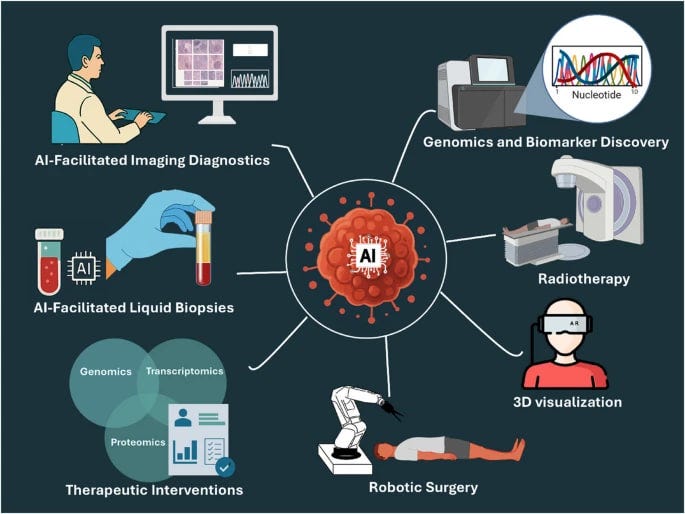
Role of artificial intelligence in the cancer treatment continuum. Source: Current AI technologies in cancer diagnostics and treatment

Not all of it is language-model work.

At the detection end, Linköping University researchers showed that a 32-sensor electronic nose can distinguish ovarian cancer in blood plasma with 97% accuracy in ten minutes—no biomarker panel, just pattern recognition across volatile compounds.

Further upstream, MIT and Microsoft developed CleaveNet, which designs peptide sensors that coat nanoparticles, circulate through the body, get cleaved by tumor-associated proteases, and shed fragments detectable in urine.

AI agents are gaining traction as well: a recent Nature article by an international team of authors, including S. Azizi from Google DeepMind, highlighted the potential of LLM-based agents in tackling complex problems across oncology research.

Roughly a year of developments, spanning diagnostics, molecular sensing, therapeutic modeling, and clinical timelines. The question worth asking isn’t whether AI is entering oncology (it already has) but what it’s actually doing there now, and why cancer turned out to be such a productive target.


📊 The Data Angle

Cancer is a highly complex disease, driven by a multitude of interacting processes within the patient’s body. To capture this complexity, the cancer research community has generated vast amounts of molecular and phenotypic data aimed at comprehensively characterizing the hallmarks of cancer. Breakthroughs in high-throughput technologies have accelerated the production of omics data, bringing in the era of “big data” in oncology. Big data in this context is defined as datasets with two key properties, they:

  1. Contain sufficiently rich information to yield novel insights into fundamental biological and clinical questions.
  2. Their storage and analysis require computational infrastructure beyond what is typically available to an individual researcher

A paradigmatic example is The Cancer Genome Atlas (TCGA) which comprises ~2.5 petabytes of raw data (roughly 500x storage capacity of a standard laptop in 2026) and necessitates specialized infrastructure for data management and analysis. Its impact has been profound: from its launch in 2008 through March 2022, TCGA was cited in at least 10,242 scientific publications and referenced in 11,054 NIH grants according to PubMed searches.

Such large-scale datasets are foundational for effective AI applications since they ensure robust training of algorithms for cancer diagnostics, early detection, therapy development, and treatment optimization.

One illustrative example of treating cancer as a data problem comes from Noetik, a San-Francisco-based biotech. Starting with non-small cell lung cancer, they’ve assembled a spatial multi-omics atlas of over 1,000 cases combining protein mapping, H&E staining, spatial transcriptomics, and whole exome sequencing to train their transformer-based AI engine, OCTO. With roughly 10% of their dataset linked to real clinical outcomes like immunotherapy response, they aim to identify which drugs work for which patients, facilitating more targeted cancer therapies.


1️⃣ Cancer Diagnostics

To read the rest of this article, upgrade to a BiopharmaTrend Pro subscription.

Gain full access to all of our deep dives and content archives.

 Upgrade to Pro 

Already a member? Sign in here.
Share:   Share in LinkedIn  Share in Bluesky  Share in Reddit  Share in Hacker News  Share in X  Share in Facebook

BiopharmaTrend.com

Where Tech Meets Bio
mail  Newsletter
in  LinkedIn
x  X
rss  RSS Feed

About


  • What we do
  • Press & Citations
  • Terms of Use
  • Privacy Policy
  • Cookies Policy
  • Disclaimer

Topics


  • News
  • AI in Bio
  • Tech Giants
  • Next-Gen Tools

Explore


  • Premium Insights
  • Business Intelligence
  • Companies
  • Events
  • Authors

Partner


  • Sponsorship
  • Editorial Calendar

© WTMB Research & Media, S.L. (WTMB Group)   2026
We use cookies to personalise content and to analyse our traffic. You consent to our cookies if you continue to use our website. Read more details in our cookies policy.