BioPharmaTrend
Latest Insights
Companies
  • Companies Directory
  • Case Studies
Newsletter
About
  • At a Glance
  • Our Team
  • Advisory Board
  • Citations and Press Coverage
  • Partner Events Calendar
  • Advertise with Us
 
 Subscribe 
Sign in
  • AI in Bio
  • Tech Giants
  • Next-Gen Tools
  • Biotech Ventures
  • Business Intelligence

  Business Intellilgence

17 More Biomedical Foundation Models

by Illia Terpylo  (contributor )   •   June 7, 2025

Disclaimer: All opinions expressed by Contributors are their own and do not represent those of their employers, or BiopharmaTrend.com.
Contributors are fully responsible for assuring they own any required copyright for any content they submit to BiopharmaTrend.com. This website and its owners shall not be liable for neither information and content submitted for publication by Contributors, nor its accuracy.

Share:   Share in LinkedIn  Share in Bluesky  Share in Reddit  Share in Hacker News  Share in X  Share in Facebook

MIT & Recursion's Boltz-2 just launched—here’s a quick scan of 15+ new models spanning chemistry, oncology, trials, and clinical workflows

The latest addition arrived yesterday: Boltz-2, an open-source model from MIT and Recursion, jointly predicts 3D molecular structure and binding affinity — two core tasks in drug discovery—at speeds reportedly 1000x faster than traditional physics-based methods like FEP. It builds on AlphaFold3 and Boltz-1, but adds affinity modeling, controllable inference, and improved physical realism (via a technique called “Botz-Steering”, we wrote about Boltz-1 in April).
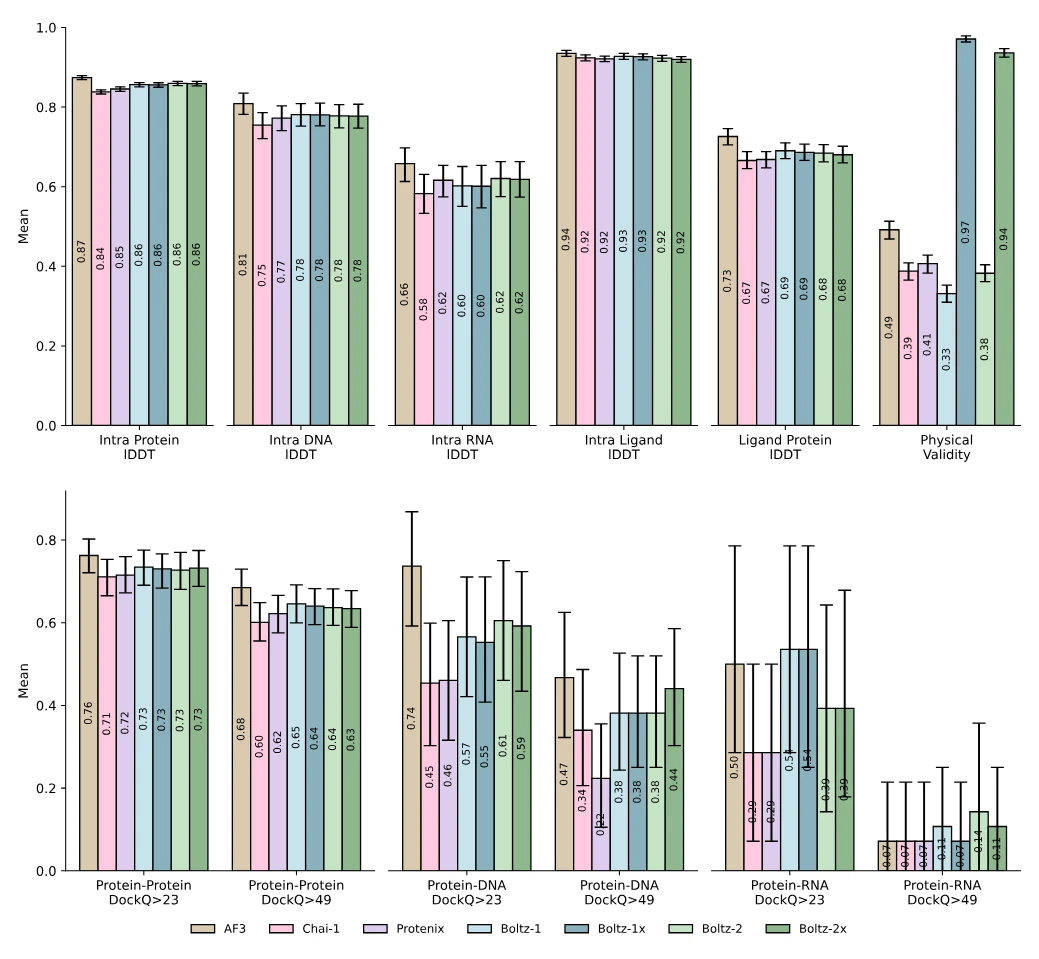
From paper: Evaluation of the performance of Boltz-2 against existing co-folding models on a diverse set of unseen complexes. Error bars indicate 95% confidence intervals.

It’s a good moment to take another look at how the space has diversified since our last overview a few months ago. One way to track that is through deal flow. Since our March scan, biopharma has leaned even harder into AI-native platforms (many anchored in foundation models) and the pattern shows up clearly in the headline agreements struck over the past year up until now.

Among several recent agreements to exemplify this (reviewed in great detail by Andrew Marshall in a recent Nature Biopharma Dealmakers piece): in June 2024, Merck KGaA paid tens of millions of euros upfront (plus €346M in potential milestones) to access Biolojic Design’s AI-created antibodies; GSK spent $37.5M on Ochre Bio’s specialized single-cell liver data; Novartis committed $65M upfront to Generate:Biomedicines' generative protein platform, and Eli Lilly invested $13M upfront in Creyon Bio’s RNA-based therapies. AstraZeneca topped these with a $200M oncology-focused deal with Pathos AI and Tempus, to leverage multimodal patient data from more than 150,000 people, making AI core to its discovery pipeline.

Brief general recap: Foundation models (2021) are large AI systems trained on massive, unlabeled datasets to recognize patterns and predict missing pieces (like the next word in a sentence or a masked part of an image). Instead of relying on labeled examples, they use self-supervised learning, adjusting millions or billions of parameters to reduce prediction errors across iterations. Most use the transformer architecture, which includes a self-attention mechanism that lets the model assess how each word (or image patch) relates to all others in the input—capturing full context regardless of order.

Rather than building new models for each use case, developers fine-tune or prompt a single pretrained system. Early examples include BERT (2018), GPT (2018–), PaLM (2022), and DALL·E 2 (2022). Many newer models support multimodal inputs like text, images, and speech.

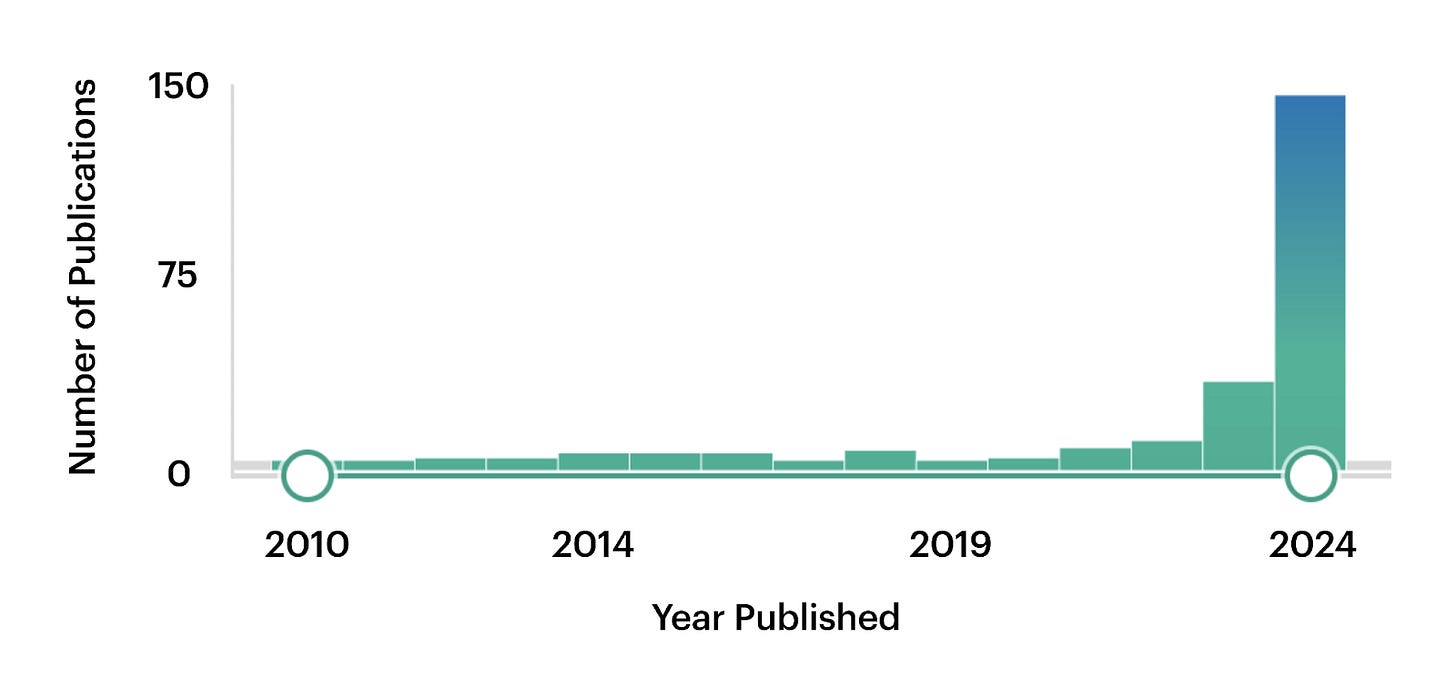
Per the recap, in biology this means combining diverse datasets (e.g. genes, proteins, chromatin) into unified frameworks, which may open new research directions. PubMed trends speak so: before 2023, mentions of “foundation model” barely hit 10 per year, then surged to around 150 by 2024.

PubMed search results for the keyword “foundation model” between 2010 and 2024. Credit: Silvin Gol & Evelien Schaafsma, Ph.D.

Historically, drug researchers have focused narrowly on one target at a time (usually a single protein) treating it as an isolated problem and going step-by-step: forming hypotheses, validating targets, screening compounds, optimizing leads, and running clinical trials, each step typically consuming considerable time and resources.

Today, FMs facilitate a more holistic view of biological systems. Key shifts enabled by this technology include:

To read the rest of this article, upgrade to a BiopharmaTrend Pro subscription.

Gain full access to all of our deep dives and content archives.

 Upgrade to Pro 

Already a member? Sign in here.
Share:   Share in LinkedIn  Share in Bluesky  Share in Reddit  Share in Hacker News  Share in X  Share in Facebook

BiopharmaTrend.com

Where Tech Meets Bio
mail  Newsletter
in  LinkedIn
x  X
rss  RSS Feed

About


  • What we do
  • Press & Citations
  • Terms of Use
  • Privacy Policy
  • Cookies Policy
  • Disclaimer

Topics


  • News
  • AI in Bio
  • Tech Giants
  • Next-Gen Tools
  • Biotech Ventures

Explore


  • Premium Insights
  • Business Intelligence
  • Companies
  • Events
  • Authors

Partner


  • Sponsorship
  • Editorial Calendar

© WTMB Research & Media, S.L. (WTMB Group)   2026
We use cookies to personalise content and to analyse our traffic. You consent to our cookies if you continue to use our website. Read more details in our cookies policy.